From Editor’s Desk
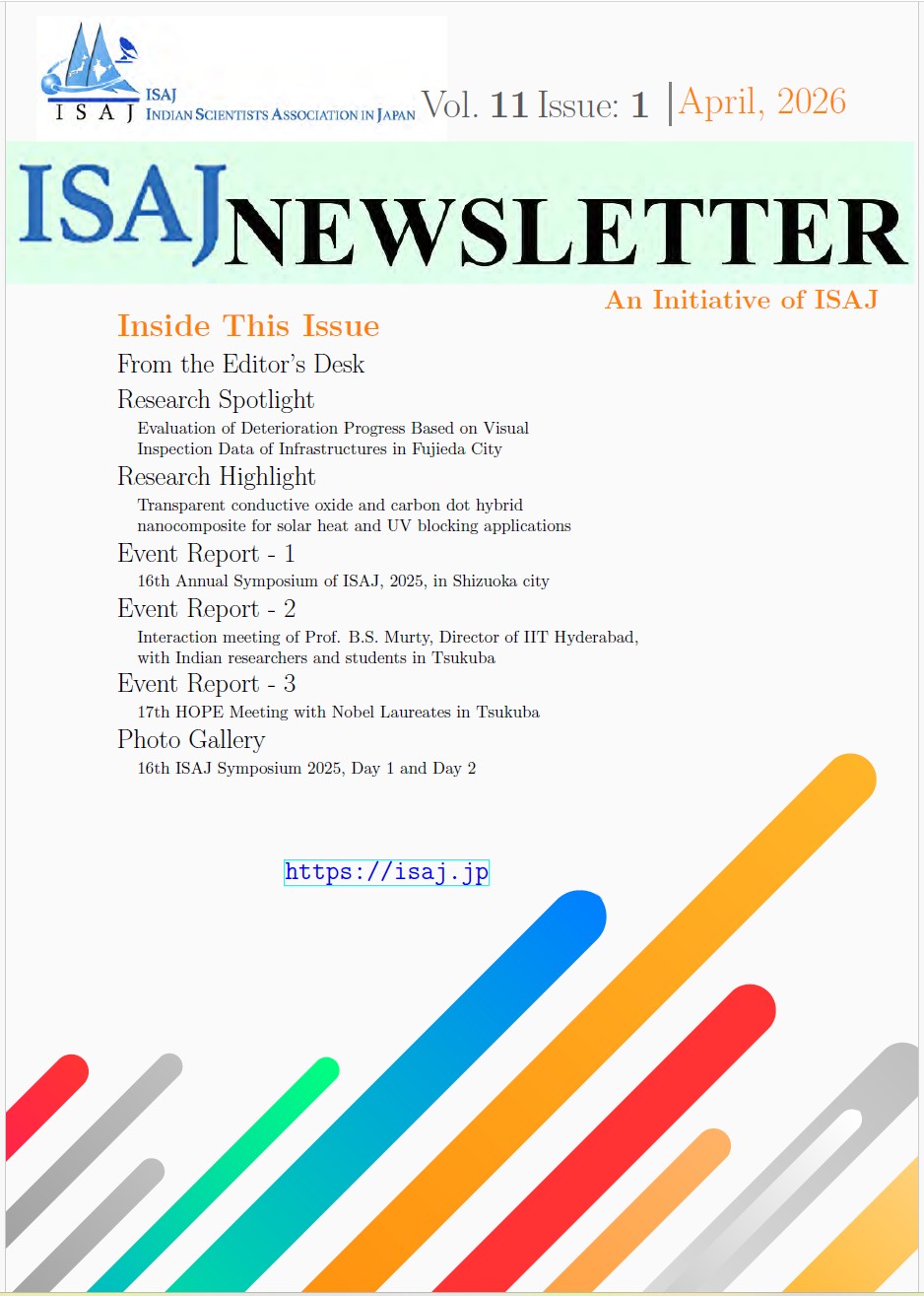
Greetings and a warm welcome to the first issue of ISAJ Newsletter in 2026! In this issue we will update you with three recent events, starting from the autumn of 2025, research spotlight on a recent undergraduate project, and research highlight from a recently awarded Ph.D.
You may notice that this is the first issue of Volume 11. We have completed 10 years of publication of our Newsletter, with one to three issues every year. It was started with an initiative of Dr. Mahendra Kumar Pal, at the time a post-doctoral researcher after a Ph.D. from University of Tokyo in 2015. Dr. Pal moved to India in 2021 and is now at Department of Civil Engineering at IIT-BHU.
In this issue, we present you with two research articles, three event reports, including one on the 16th ISAJ Annual Symposium 2025 held in November of the last year in Shizuoka city, and three photo galleries of the symposium.
The Research Spotlight is on an undergraduate research by Ms. Miyu Ohtake of Shizuoka Institute of Science and Technology, which was presented at 16th Annual Symposium of ISAJ in Shizuoka city in November 2025. This poster presentation won a presentation award at this symposium. It is on a very important contemporary problem of aging infrastructure in Japan. Deterioration of bridges by age, length and material as factors was surveyed in a city.
The Research Highlight is on the recently completed Ph.D. by Dr. Adrija Das at National Institute for Materials Science (NIMS) and Hokkaido University, in which she developed a hybrid for transparent coating for glass facades in modern buildings. Tin-doped indium oxide (ITO) offers high visible transmittance and strong NIR absorption. A hybrid nanocomposite ITO-CD was developed by combining ITO with high UV-A blocking nitrogen-doped carbon dots (CDs). The film was spin-coated on glass.
This issue contains three event reports:
- The first one is on the two days 16th Annual Symposium of ISAJ, held on Nov. 28-29 in city campus of Shizuoka Institute of Science and Technology (SIST). See also the Photo gallery and the back cover.
- The second event report is on an interaction session of Prof. B.S. Murty, Director of IIT Hyderabad, with Indian researchers and students in and around Tsukuba Science city, organized by the Tsukuba Chapter of ISAJ.
- The third event report is on 17th HOPE Meeting with Nobel Laureates, organized by JSPS in Tsukuba at the beginning of March. Dr. Upasana Jhariya of Tohoku University reports.
There are three Photo Galleries of glimpses of ISAJ 2025 symposium.
If you find any interesting science and technology events near you, and you would like to report on it in our Newsletter, please write to the editors (see contact emails on the back cover).
We hope you would find the present issue of our Newsletter interesting. We look forward to receiving your feedback. Any suggestions/ideas for improving the upcoming newsletters are welcome.
Research Spotlight: Evaluation of Deterioration Progress Based on Visual Inspection Data of Infrastructures in Fujieda City
By Ms. Miyu Ohtake, Department of Civil Engineering, Shizuoka Institute of Science and Technology, Shizuoka, Japan
Introduction
This study investigates the deterioration of road bridges in Fujieda City, Shizuoka Prefecture, using proximity visual inspection data and a Markov chain model. Although Japan mandates close visual inspections every five years, many local governments lack the personnel and financial resources to effectively utilize the accumulated inspection data. The objective of this research is to develop a practical statistical method that can support future maintenance planning for regional municipalities.
Methodology
Inspection results from 309 bridges with known construction years were analyzed by grouping them into 10-year age categories. To enhance reliability, two datasets were compared—simple 10-year intervals and 10-year intervals with 5-year overlaps. The latter was adopted because it provided a more stable distribution of transition rates. The Markov chain model was then applied to estimate deterioration transition rates among the four soundness levels defined by national inspection standards.
Deterioration by Age, Length and Material — Factors Influencing the Transition Rate
The results indicate that deterioration accelerates significantly for bridges older than 60 years. Bridge length also plays an important role: structures longer than 5 meters deteriorate more rapidly than shorter ones. After 50 years, the proportion of bridges reaching the lowest soundness level (IV) is 2.7 times higher for longer bridges. Material differences further influence deterioration trends. Steel bridges exhibit the fastest decline in structural soundness, followed by prestressed concrete (PC) bridges, while reinforced concrete (RC) bridges deteriorate the slowest.
Conclusions
The study concludes that bridge age, length, and material significantly affect deterioration rates, and that the Markov chain model is an effective tool for organizing inspection data and predicting future structural conditions. These findings can support more efficient maintenance and management strategies for local governments facing resource limitations.
Miyu Ohtake has just graduated from the Department of Civil Engineering, Faculty of Science and Engineering, Shizuoka Institute of Science and Technology, and is now working as a site supervisor at Entetsu Construction Co. Ltd. from April 2026. Any comments may be addressed to her graduate project supervisor Prof. T. Nishida ([email protected]).
Research Highlight: Transparent Conductive Oxides and Carbon Dots Hybrid Nanocomposite for Solar Heat and UV Blocking Applications
By Dr. Adrija Das, NIMS, Tsukuba, Japan
Introduction
Rising global temperatures, driven by urbanization and fossil fuel overconsumption, are placing enormous pressure on energy systems. In built environments, buildings lose 30–40% of their total energy to air-conditioning. A key contributor is solar heat: near-infrared (NIR) radiation accounts for ~52% of incoming solar radiation, and modern buildings with extensive glass facades transmit nearly all of it indoors, increasing cooling loads and energy costs. Additionally, harmful solar ultraviolet (UV) radiation, especially UV-A radiation (315–400 nm), penetrates human skin and increases the risk of skin cancer. Blocking solar heat and UV-A with window coatings is therefore both an energy-efficient and a human health priority.
Current commercial windows use thin silver films to address heat gain. Silver’s plasmonic nature makes it highly reflective in the visible and NIR, but its UV-blocking capability is poor. Importantly, silver must be fabricated in very thin films (<8 nm) to allow visible light to pass through while blocking NIR radiation. Silver, as a thin film, is unstable and discontinuous. To compensate, silver layers are sandwiched between dielectric layers and stacked in multi-layer configurations, which can compromise visible light transparency. Moreover, this is a complex, costly architecture, limiting adoption particularly in lower-income economies in hot tropical regions.
To combat such issues, in our group, under the supervision of Prof. Nagao at the National Institute for Materials Science (NIMS) and Hokkaido University have researched potential material alternatives and developed a hybrid nanocomposite of transparent conductive oxides and metal-free carbon dots that exhibit enhanced NIR and UV-A blocking while maintaining visible transparency for application as window and skylight coatings.
Approach: Concept and Development
Choosing the right materials in NIR and visible wavelengths: Wide-band gap semiconductors such as tin-doped indium oxide (ITO) offer high visible transmittance owing to a large band gap (bandgap >3.6 eV). ITO with a high free carrier concentration retains certain metallic properties, such as high conductivity. In ITO nanoparticles, localized surface plasmon resonance arising from the collective oscillation of free electrons coupled with incoming radiation produces strong NIR absorption. Crucially, nanoparticle shape and size can be tuned to target specific NIR wavelengths, enabling controlled solar heat blocking while preserving high visible transparency. Choosing ITO nanoparticles helps achieve such criteria to develop an energy-efficient coating. However, we observed that the UV-A blocking efficiency of ITO was very limited.
Choosing the right materials in UV wavelengths: Carbon-based semiconducting materials exhibit exceptional UV blocking through absorption in the UV-A range. One such material is nitrogen-doped carbon dots (CDs), which range ~5 nm in size, containing a carbon core and free functional groups attached to it. Unlike conventional UV blockers such as zinc oxide or titanium dioxide, CDs are metal-free, making them a sustainable and eco-friendly alternative. Nitrogen doping narrows the bandgap through defect states introduced from lone pair of electrons from nitrogen, enabling absorption in longer UV wavelengths (UV-A). CDs, in our testing, outperformed zinc oxide with a stronger absorption in the UV-A, confirming their suitability for this application.
Hybrid nanocomposite: Combining the properties of NIR blocking and visible light transmittance of ITO nanoparticles and high UV-A blocking of nitrogen-doped CDs, we formed a hybrid nanocomposite (ITO-CD) film that blocks NIR and UV-A while maintaining high visible transparency. The ITO-CD film was spin-coated on glass. Interestingly, ITO-CD exhibited enhanced NIR absorption, beyond what either of the individual materials’ properties, indicating a synergistic interaction rather than simple additive effects obtained when CDs were combined with ITO nanoparticles.
Results
ITO-CD hybrid film for transparent coating applications: ITO-CD hybrid films achieved spectrally selective blocking through absorption in the UV-A (315-400 nm) and NIR (780–2500 nm) regions while maintaining visible light (400–780 nm) transparency. ITO nanoparticles inherently absorbed NIR radiation, while CDs provided strong UV-A absorption. Compared to an ITO nanoparticle film, the ITO-CD film exhibited a different surface morphology. The ITO nanoparticle film (0.2 μm thick) had a closely packed, uniform structure that transformed into a highly porous ITO-CD film (0.9 μm thick) upon combination with CDs. This transformation was driven by Coulombic attraction, where free surface amine groups (–NH₂) on the CDs bound to negatively charged ITO nanoparticles, promoting heavy aggregation and generating a random configuration of aggregates (clusters) and pores. XPS and XRD confirmed that CDs did not alter intrinsic chemical or crystallographic properties of ITO, confirming their role in surface morphological changes exclusively.
Solar heat and UV-A blocking performance: ITO-CD films were evaluated under real solar irradiance conditions. They achieved a maximum NIR blocking of 76% and UV-A blocking of 81%. When applied to an in-lab miniature house model, ITO-CD films reduced indoor temperatures by 9-11°C compared to a glass with no coating. Moreover, thicker ITO-CD films with high haze can be applied to skylights where diffuse daylight entry is desirable without glare or direct overhead incidence, while still delivering efficient solar heat and UV-A blocking. Film thickness, therefore, provides a single tuning parameter to transition between transparent and hazy films, broadening the application scope from windows to skylight, confirming their effectiveness as tunable high-efficiency solar heat and UV-A blocking films.
CWO-CD hybrid film for transparent coating applications: While ITO-CD demonstrated successful results as a hybrid film for solar heat and UV-A blocking, ITO as the most widely used transparent conductive oxide (TCO), was chosen for its excellent optical properties in the NIR and visible wavelengths. We therefore explored other TCOs with plasmonic absorption peaks in the shorter NIR range (780–1200 nm), where solar irradiance is most intense. This led us to cesium tungsten oxide (CWO), which exhibits an absorption peak between 700–1100 nm, shifted to shorter wavelengths relative to ITO, offering stronger absorption in the NIR. Like ITO, CWO combines high visible transparency with plasmonic NIR absorption, making it well-suited for transparent heat-blocking applications. Applying the same strategy established with ITO-CD, we combined CWO nanoparticles with CDs to fabricate a hybrid film on glass by drop-casting. The results followed the same mechanism as observed in the ITO-CD system. The best CWO-CD films achieving NIR and UV-A blocking efficiencies of 92% and 85%, respectively, and reduced indoor temperatures by up to 12°C in a miniature house model.
Prospects
These results establish TCO-CD hybridization as a design strategy. CDs serve a dual function as UV-A absorbers and as agents that promote nanoparticle aggregation and enhance spectral selectivity. The sole parameter of film thickness achieved tunable optical output across UV-Vis and NIR wavelengths. The approach is particularly well-suited to tropical, lower-income regions where intense solar heat and UV-A exposure pose significant challenges to thermal comfort and energy efficiency. CWO nanoparticles are cost-effective, and the fabrication method is simple. Adoption of other TCOs for such TCO-CD coatings could drive the development of new hybrid material solutions combining the plasmonic tunability of specific TCOs with the abundant and eco-friendly carbon dots, paving the way for such heat and UV-A blocking transparent films.
Event Report 1: 16th Annual Japan–India Symposium on Science & Technology, ISAJ 2025
Shizuoka city, 28–29 November 2025 — Report by Prof. Kedarnath Mahapatra, Convener
The 16th Annual Symposium of the Indian Scientists Association in Japan (ISAJ) was successfully held on 28–29 November 2025 at the Ekimae Campus of the Shizuoka Institute of Science and Technology (SIST) in Shizuoka City. This campus is housed in a modern building opposite the Shizuoka railway station, which is also a stop for some of the Tokai line Shinkansen (Bullet) trains from Tokyo to Osaka. The symposium was co-organized with SIST. It was supported by the Embassy of India in Japan, as in every year. It was held during the India–Japan Year of Science, Technology, and Innovation Exchange (2025–2026), highlighting ISAJ’s ongoing commitment to strengthening bilateral scientific cooperation.
Over the last few decades, Japan’s role in India’s urban transformation has been significant, primarily through financial and technical assistance for infrastructure development, particularly in transportation and urban planning. Japan also provides technical assistance and knowledge transfer to India in areas such as disaster management and sustainable urban development. Since most of the Japanese companies and organizations associated with such projects are located around Tokyo, it was decided to organize the symposium in Shizuoka Prefecture to provide an opportunity to the potential stakeholders from the region to listen to the domain experts from both countries on diverse issues associated with planning and managing the infrastructure projects in India, and explore the possibilities in future. Against this background, and in view of 2025-2026 being celebrated as the India-Japan Year of Science, Technology, and Innovation Exchange, the symposium focused on the role of the Japan-India partnership in accelerating science, technology, and circular innovation for India’s urban transformation.
Shizuoka Prefecture is home to Mt. Fuji and houses some of the well-known industries, many of which are heavily involved in infrastructure development and other areas in India (Hamamatsu City is home to Suzuki’s headquarters and Honda and Yamaha factories). This, together with the fact that the convener of the symposium, Prof. Mahapatra, and his colleagues, especially Prof. Takahiro Nishida, supporting the symposium, are from the Civil Engineering department of SIST, with academic interest in urban infrastructure, encouraged us to organize the focused sessions of the symposium with the theme “Circular Innovation for Urban Transformation and Beyond” on the first day. This brought together senior representatives of Japan Railway Construction, Transport and Technology Agency (JRTT) (Ahmedabad High-Speed Rail), PADECO Co. Ltd. (underground railway development in Mumbai), Remote Sensing Technology Center of Japan, Showa Sekkei, among others. To connect seamlessly with participants from industry and academia, professional simultaneous English–Japanese interpretation was provided on the first day.
The day’s proceedings began with a welcome from Prof. Mahapatra as the symposium convener, followed by opening addresses by Prof. Masakazu Kimura, President of SIST, and Dr. Yashawant Dev Panwar, Counsellor (Science & Technology), Embassy of India in Japan. The keynote lecture of the symposium was given by Prof. Muralidhar Miryala of Shibaura Institute of Technology, which emphasized the role of high-temperature superconductors in achieving a net-zero energy future, setting a forward-looking tone for the symposium. This was followed by two Special Plenary lectures delivered by domain experts with extensive experience in India’s urban infrastructure development, focusing on a high-speed rail project and metro projects in Indian cities.
The first special plenary lecture was delivered by Dr. Kunaiki Minami of JRTT on a very important theme: Technical Exchange Between Japan and India for Quality Assurance of Steel Bridges in the Mumbai–Ahmedabad High-Speed Rail Project. The second plenary lecture was delivered by the Executive Director of PADECO Co. Ltd., Mr. Yoshiya Nakagawa, who is an expert in planning India’s metro projects and popularly known as “Metro-guy”. He presented a very insightful and thought-provoking talk on Urban Transformation in Mumbai through the Underground Railway.
Later that day, in a special invited talk, Mr. Yuji Nishikawa of the Japan Science and Technology Agency (JST) explained JST’s International Programs for Young Researchers from India and Other Countries. This was followed by three plenary talks by the domain experts on their areas of expertise: 1) Dr. Remi Chandran of the Remote Sensing Technology Center of Japan (RESTEC) dealing with Importance of Digital Public Infrastructure for People and Planet: Addressing Human–Nature Conflicts Across Asia and Africa, 2) Dr. Tomoya Inami of SIST introducing a New Processing Technique for the Sustainable Use of Rice Husks and Residues to Address the Urban Air Pollution Problem in North India 3) Mr. Shohei Koike of Showa Sekkei, Shizuoka, about Establishing a Control System for Alligator Weed (Alternanthera philoxeroides) through Industry-Government-Academia-Civil Society Collaboration: Background and Approaches in the Case of Asahata Retention Basin. A lively panel discussion concluded the day, underscoring the importance of multi-stakeholder cooperation among academia, industry, government, and civil society, which was coordinated by Prof. Tomonori Tominaga.
The second day commenced with an inaugural video message from H.E. Ms. Nagma Mohamed Mallick, Ambassador of India to Japan, reaffirming the importance of long-term scientific partnerships between the two countries. This was the first time for the symposium to be held in a place that was not surrounded by big universities (except the only national university in the prefecture, Shizuoka University) and research institutions. However, there was an overwhelming response to participation. Invitations were readily accepted by senior scientists and academics from near and far. There were representations from Kitami Institute of Technology, Akita University, and Tohoku University in the north, Shizuoka University and Nagoya University nearby, and Hiroshima University, Osaka, and Kyoto University in the west, as well as visiting academics from India. Larger participation was from Tsukuba Science City and Tokyo. An overwhelming number of presentations necessitated holding parallel sessions in two different lecture halls in the afternoon of the second day.
There were 28 oral presentations (including plenary and invited) on this day across 4 sessions, and 23 poster presentations. The topics were very diverse, multidisciplinary, and cutting-edge. Consequently, the sessions were also multidisciplinary, which included materials science, renewable energy, climate and disaster resilience, biomedical research, nanotechnology, electronics, cultural heritage science, and space robotics. Research aligned with circular innovation, such as sustainable materials, self-healing concrete, advanced battery technologies, environmental remediation, and climate resilience, received particular attention. Biomedical sessions highlighted advances in Alzheimer’s disease research, biodegradable metals, biosensors, and neuroimaging, while engineering sessions showcased progress in ultra-low-power electronics, magnetic materials, and next-generation data storage technologies, sparking lively discussions.
The poster sessions, with strong participation from early career researchers and students, fostered active cross-disciplinary interaction. Four Best Poster Presentation Awards were presented to recognize outstanding contributions, reaffirming ISAJ’s commitment to nurture young researchers. These were for research on (i) “PD-L1 Blockade Induces Tumor-Specific Lethal Coagulopathy via IL-6–Mediated Thrombin Activation in mice” by Surabhi Raman of Kyoto University, (ii) “How does Tungsten start deforming?” by Florian Tropper of National Institute for Materials Science (NIMS), (iii) “Evaluation of Deterioration Progress Based on Visual Inspection Data of Infrastructures in Fujieda City” by Miyu Ohtake of SIST, and (iv) “Design and optimization of FePt-based multilevel HAMR media for high-capacity and energy-efficient data storage” by Helen Sibi of NIMS. Each award contained a certificate and shopping coupons.
The symposium concluded with poster awards and closing remarks by Prof. Kedarnath Mahapatra, who commended the high scientific quality of the presentations and the strong collaborative spirit among participants. On behalf of the Organizing Committee, he expressed sincere gratitude to the Embassy of India in Japan for its longstanding patronage; SIST for hosting the event as co-organizer; our esteemed donor, Sai Hira India Foundation (SHIF); our main sponsor Indian Commerce and Industry Association in Japan (ICIJ), and equally important sponsors Forecast Ocean Plus, Inc. (FOP), Suzuyo Construction Co., and Ambika Corporation for their generous support. He expressed appreciation to all volunteers for their invaluable contributions.
The 16th ISAJ Annual Symposium 2025 once again reaffirmed ISAJ’s role as a vibrant platform for India–Japan scientific collaboration, promoting interdisciplinary dialogue and advancing shared visions for sustainable urban futures, technological innovation, and scientific excellence.
The annual symposia in recent years are also a marker of how far the Indian research community in Japan has come in the past 16 years. In the early years we could barely fill one day’s program. Talks could be neatly organized into only four sessions across different research fields. Today, any talk would be difficult to fit into a single field. All participants are intensely involved in every talk and session. Members of the community have risen in ranks to become junior and senior faculty members and researchers. They are plenary speakers and participate with their students.
Event Report 2: A Memorable Interaction with Prof. B. S. Murty in Tsukuba
Report by Dr. Soumyaranjan Rath, NIMS, Tsukuba
The Indian scientific community in Japan witnessed an inspiring and intellectually enriching event on 23rd February 2026, as the Indian Scientists Association in Japan (ISAJ) had the privilege of hosting Prof. B. S. Murty, Director of IIT Hyderabad, at Co-working space in Tsukuba Center. The gathering brought together more than 40 Indian researchers, students, and professionals working across various domains of science and technology in Japan. The event served as a vibrant platform for interaction, reflection, and motivation, strengthening the connection between Indian researchers abroad and the evolving scientific landscape of India.
The program commenced with a warm and gracious welcome address by Dr. Alok Singh, Co-Chair of ISAJ, who highlighted the importance of such interactions in fostering a unified scientific community. Dr. Sunil Kaul, Chairman of ISAJ, co-chaired. Several distinguished researchers, including Dr. Archana Kulshreshtha and many of Prof. Murty’s former students currently contributing to industries in Japan, were also present, adding depth and diversity to the gathering.
In his keynote interaction, Prof. Murty shared his visionary outlook on advancing science and technology in India, emphasizing the critical role of young researchers in shaping the nation’s future. His talk seamlessly blended strategic insights with personal experiences, making it both intellectually stimulating and deeply relatable.
One of the most inspiring moments of the session was when Prof. Murty reflected on his own journey—from being a postdoctoral fellow to becoming a leading academic figure. His story resonated strongly with the audience, offering a powerful reminder: “Every great journey in science begins with curiosity, perseverance, and the courage to dream beyond boundaries.”
His words ignited a sense of purpose among the attendees, encouraging them to contribute meaningfully to the global scientific ecosystem while staying connected to India’s growth. The event was further enriched by interactive discussions, where participants engaged directly with Prof. Murty, sharing ideas, experiences, and aspirations. The session concluded with a vote of thanks, followed by informal interactions and networking.
The meetup was not just an event, but a celebration of shared identity, scientific ambition, and collective inspiration. It reaffirmed the strength of the Indian research community abroad and its potential to contribute significantly to the advancement of science and technology.
Event Report 3: JSPS 17th HOPE Meeting with Nobel Laureates, Tsukuba
Report by Dr. Upasana Jhariya, Tohoku University, Japan
The JSPS HOPE Meeting is a prestigious program organized by the Japan Society for the Promotion of Science (JSPS) that brings together outstanding early-career researchers from the Asia–Pacific region. Held annually, the program aims to foster interdisciplinary exchange and provide young scientists with the opportunity to interact with world-leading researchers, including Nobel Laureates. Through lectures, discussions, and collaborative activities, the meeting encourages participants to broaden their scientific perspectives and build international research networks.
I had the opportunity to attend the JSPS HOPE Meeting from 1 March to 6 March 2026 at the Tsukuba International Congress Center. The program brought together about one hundred young researchers from various countries and included lectures delivered by six Nobel Laureates. Their lectures were highly informative and inspiring. Most valuable aspect of the program was opportunity to interact directly with the Nobel Laureates. Through discussions, I learned about their research journeys, the challenges they faced, and the motivations that guided their work. Their insights were extremely inspiring and reinforced the importance of persistence and collaboration in scientific research.
During the meeting, I presented my research through a poster presentation and a flash talk titled “Localized Iron Compound Synthesis Using Immobilized Acidithiobacillus ferrooxidans Around Iron Surface for Toxic Selenate Removal.” This presentation allowed me to share my work with an international audience and receive constructive feedback from researchers from diverse fields.
In addition, the meeting provided an excellent platform to interact with fellow participants. I had the opportunity to meet approximately 100 young researchers from different countries and disciplines. Through these interactions, I exchanged research ideas, discussed scientific challenges, and developed new international connections. These discussions helped me better understand the diversity of research being conducted around the world and highlighted the value of interdisciplinary collaboration.
Overall, participating in the JSPS HOPE Meeting was an enriching and motivating experience. It strengthened my enthusiasm to continue pursuing meaningful scientific research. For me, attending this program was truly a once-in-a-lifetime opportunity, and I believe that every young researcher should experience such a platform to learn from leading scientists and engage with the global scientific community.