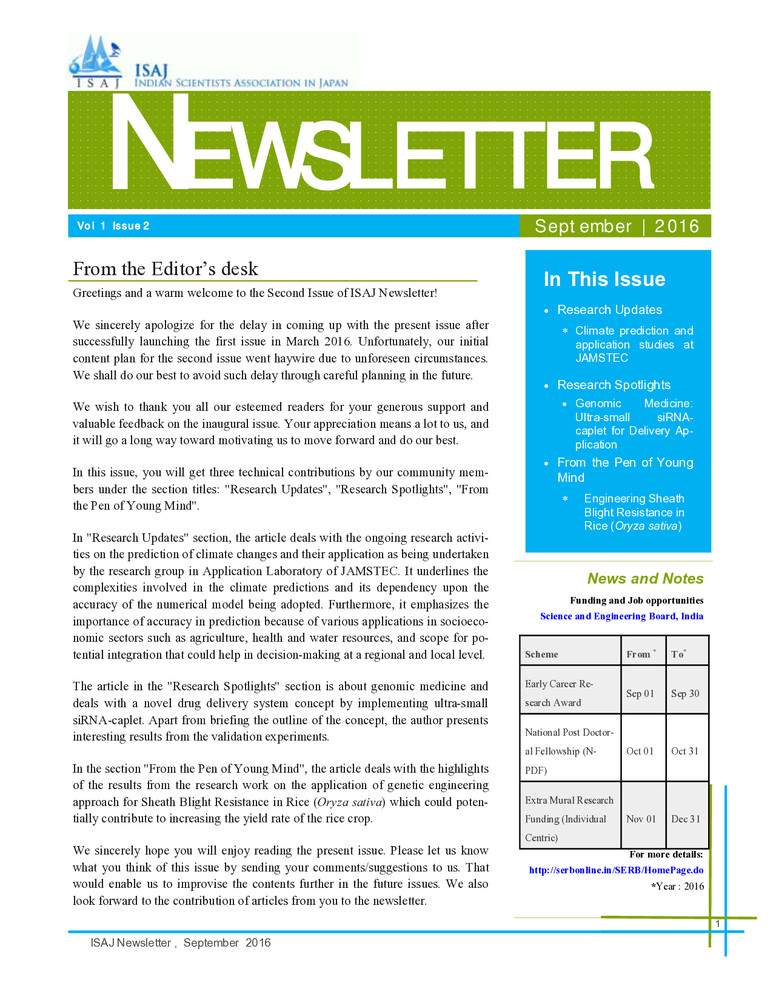
The second issue of ISAJ Newsletter presents cutting-edge research from our community members, including climate prediction and application studies at JAMSTEC, breakthrough innovations in genomic medicine with ultra-small siRNA delivery systems, and genetic engineering approaches for developing sheath blight resistance in rice.
Important takeaways and highlights from this issue
Climate Prediction Advances.
JAMSTEC's Application Laboratory develops high-resolution coupled models (SINTEX-F) for predicting climate phenomena like El Niño, IOD, with applications in agriculture, health, and water resources
Genomic Medicine Breakthrough.
Novel ultra-small siRNA-nanocaplet delivery system (<10nm) demonstrates efficient cellular uptake and selective kidney accumulation, offering promising treatment for renal diseases
Rice Disease Resistance.
Genetic engineering approach using transcription factors OsPFT1 and OsMYC shows enhanced resistance to sheath blight disease, addressing 5-8% crop yield losses
Societal Applications.
Integration of seasonal climate forecasts with decision-making systems for agriculture, water management, and disease control in developing countries
Article Summaries
Below you'll find condensed summaries from our newsletter articles.
To explore complete research details, figures, and references, view the full newsletter.
From the Editor’s Desk
Greetings and a warm welcome to the Second Issue of ISAJ Newsletter!
We sincerely apologize for the delay in coming up with the present issue after successfully launching the first issue in March 2016. We wish to thank you all our esteemed readers for your generous support and valuable feedback on the inaugural issue. Your appreciation means a lot to us, and it will go a long way toward motivating us to move forward and do our best.
In this issue, you will get three technical contributions by our community members under the section titles: “Research Updates”, “Research Spotlights”, and “From the Pen of Young Mind”.
Research Updates: Climate Prediction and Application Studies at JAMSTEC
By Dr. Satyaban B. Ratna, Japan Agency for Marine-Earth Science and Technology (JAMSTEC)
Weather and climate forecasts on timescales of days to seasons are very important to reduce vulnerability to extreme floods and droughts. Our research group in Application Laboratory of JAMSTEC has been involved with research on seasonal climate forecasts for the last few decades.
Key Research Areas
Tropical air-sea coupled climate phenomena such as El Niño/Southern Oscillation (ENSO), ENSO Modoki, Indian Ocean Dipole (IOD), subtropical Indian Ocean dipole, Ningaloo Niño, California Niño and Dakar Niño have significant impacts on our society. We are trying to predict such climate modes because accurate predictions and dissemination of predicted information are important to mitigate influences of extreme weather and climate events.
The SINTEX-F Model
We have been investigating oceanic and atmospheric processes responsible for climate and ocean variations, mostly using a high-resolution coupled model (SINTEX-F) and other available observations. The SINTEX-F model has been known to predict IOD, ENSO and other climate modes on long lead-times. Our seasonal predictions are generated every month and made available on the JAMSTEC website.
Societal Applications
Recently we have started to use seasonal forecasts for societal applications in different socioeconomic sectors:
Agriculture: Cultivation and harvesting planning
Health: Disease control (malaria, cholera, dengue)
Water Resources: Water management and drought/flood warnings
Regional Scale: Using downscaling approach with regional climate models at higher spatial resolution (up to 5km)
Research Spotlights: Genomic Medicine - Ultra-small siRNA-caplet for Delivery Application
By Dr. PK Hashim, The University of Tokyo
Disaster diseases such as cancer affect millions of people worldwide, accounting for 8.2 million deaths in 2012. Traditional chemotherapy has limitations including undesired side effects. Genomic medicine using gene fragments (e.g., siRNA) as pharmaceutical agents offers an excellent alternative with 100% efficiency while avoiding undesired targets.
Innovation in Delivery Systems
We present the construction of a siRNA/carrier conjugate smaller than 10 nm using a polymer chemistry approach. A water-soluble Gu+ monomer bearing two thiol termini undergoes disulfide polymerization upon oxidation in the presence of a siRNA-template to form polymer-siRNA complexes (siRNA-nanocaplet).
Key Findings
Uniform size confirmed by cryogenic transmission electron microscopy (cryoTEM) and dynamic light scattering (DLS)
Stable against serum proteins
Efficient cellular uptake demonstrated through confocal laser scanning microscopy
Successful gene suppression in Hep3B cells without notable toxicity
Selective accumulation in kidney upon in vivo administration, suggesting potential for treating renal diseases
From the Pen of Young Mind: Engineering Sheath Blight Resistance in Rice (Oryza sativa)
By Ambika K. Dudhate, The University of Tokyo
Sheath blight is a fungal disease of intensive rice production caused by R. solani, reducing crop yield by 5-8%. Only partial genetic resistance has been reported so far, and traditional breeding is laborious and complicated by cross-ability barriers.
Genetic Engineering Approach
This study analyzed the role of two transcription factors:
OsPFT1 (Phytochrome and Flowering Time 1): Mediator complex in disease resistance
OsMYC: A negative transcription factor against defense-related pathways
Results
OsPFT1 Overexpression: Generated 16 putative transgenic plants; two out of three events showed enhanced resistance
OsMYC Silencing: Generated 21 putative transgenic plants showing enhanced resistance compared to control plants
Bioassays demonstrated significant improvement in sheath blight resistance
This genetic engineering approach offers a promising alternative to traditional breeding and fungicide use, addressing both environmental and health concerns while improving crop yields.
Funding Opportunities
The Science and Engineering Research Board (SERB), India announces various funding schemes:
Early Career Research Award (September 1-30)
National Post Doctoral Fellowship (October 1-31)
Extra Mural Research Funding (November 1 - December 31)
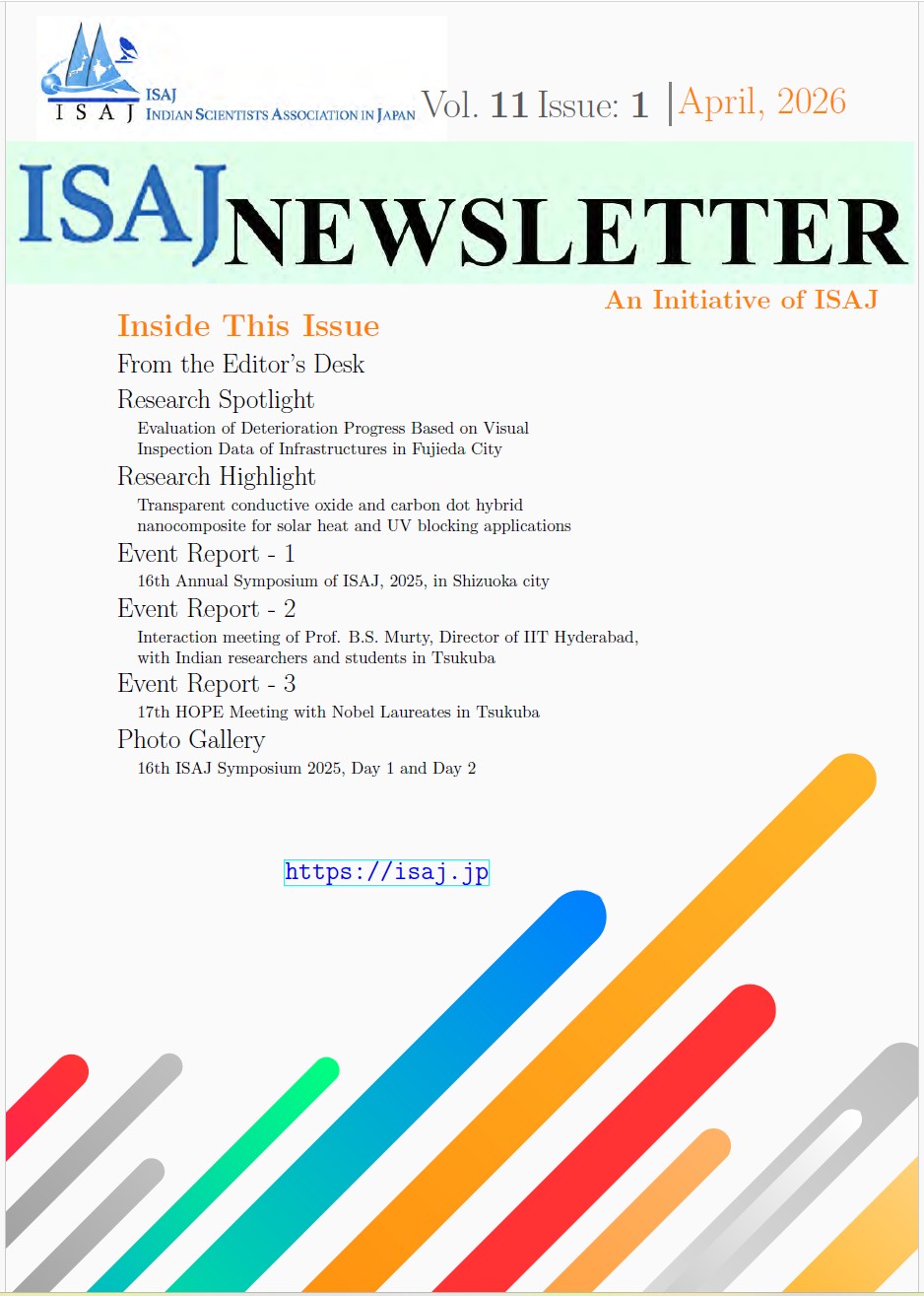
Marks 10 years of ISAJ Newsletter publication, featuring research on bridge deterioration analysis in Fujieda City, transparent conductive oxide and carbon dot nanocomposites for solar heat and UV blocking, and event reports from the 16th ISAJ Symposium, Prof. B.S. Murty's Tsukuba interaction, and the 17th JSPS HOPE Meeting.
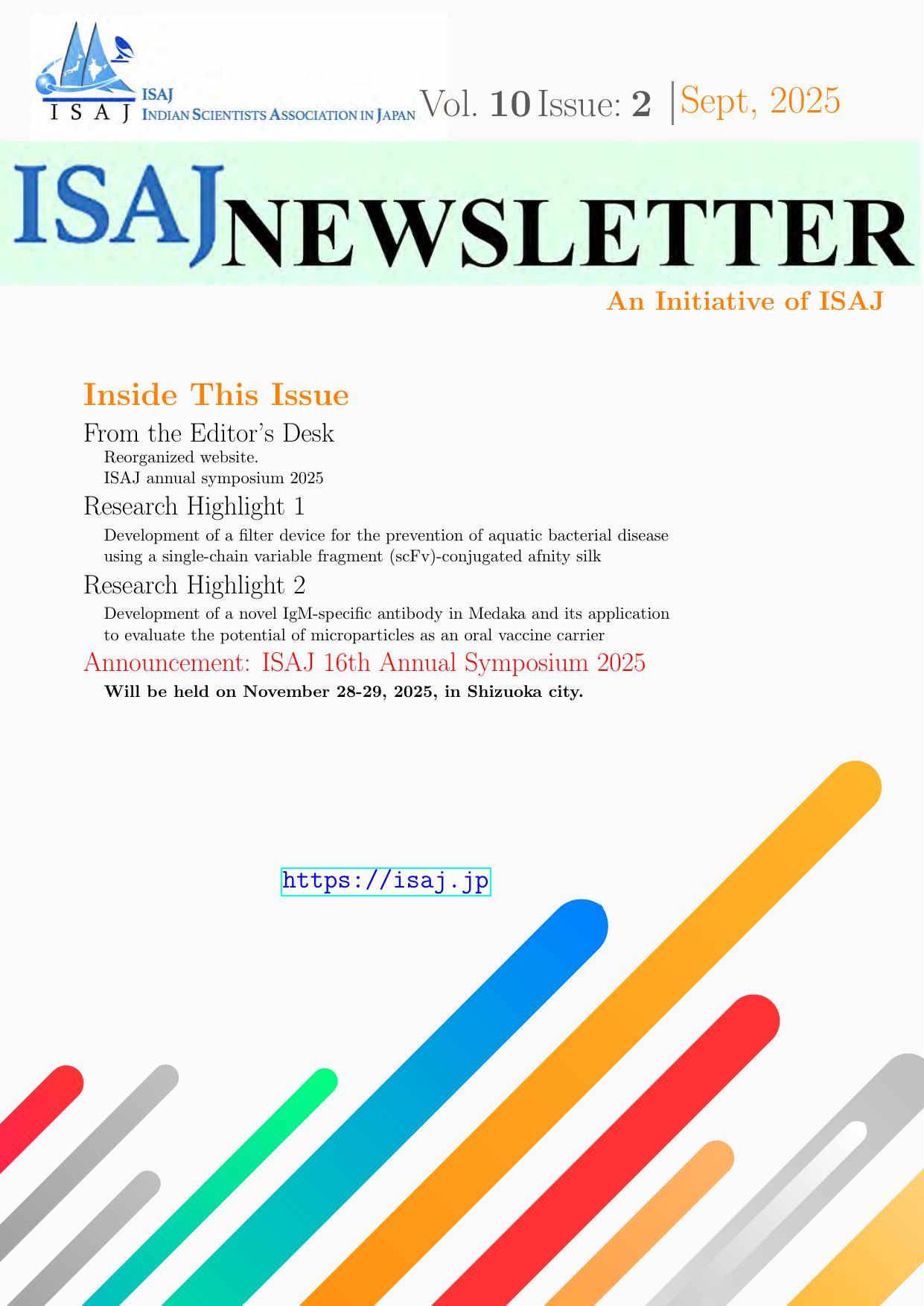
Features research on aquatic bacterial disease prevention using affinity silk filters, IgM-specific antibodies in Medaka for vaccine development, and ISAJ 16th Symposium announcement
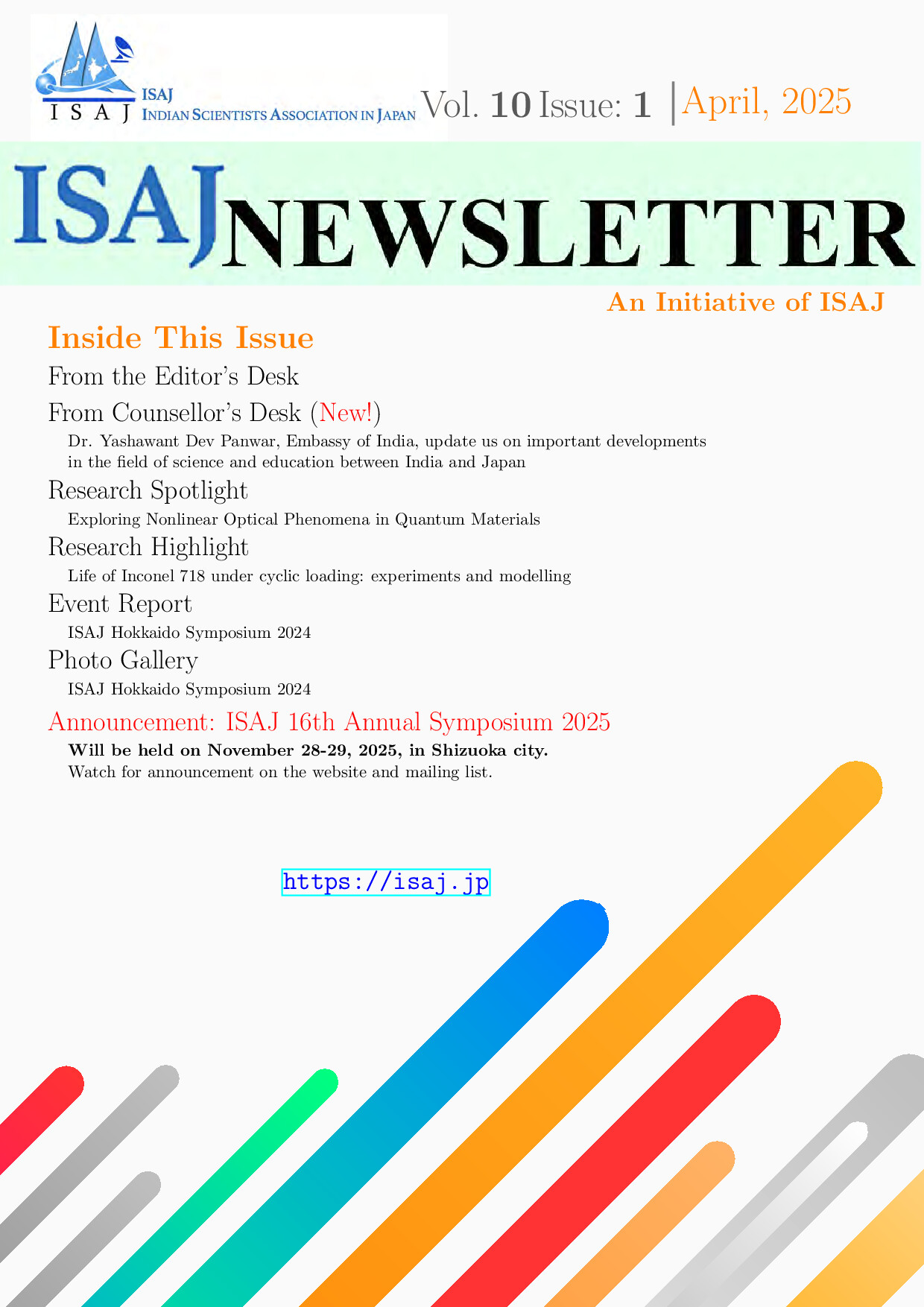
Features India-Japan STI Exchange Year, nonlinear optical phenomena in quantum materials, Inconel 718 fatigue modeling, and ISAJ Hokkaido Symposium 2024
Loading search index
Please wait while we prepare search...
No results found
We couldn't find anything with that term. Please
try again.