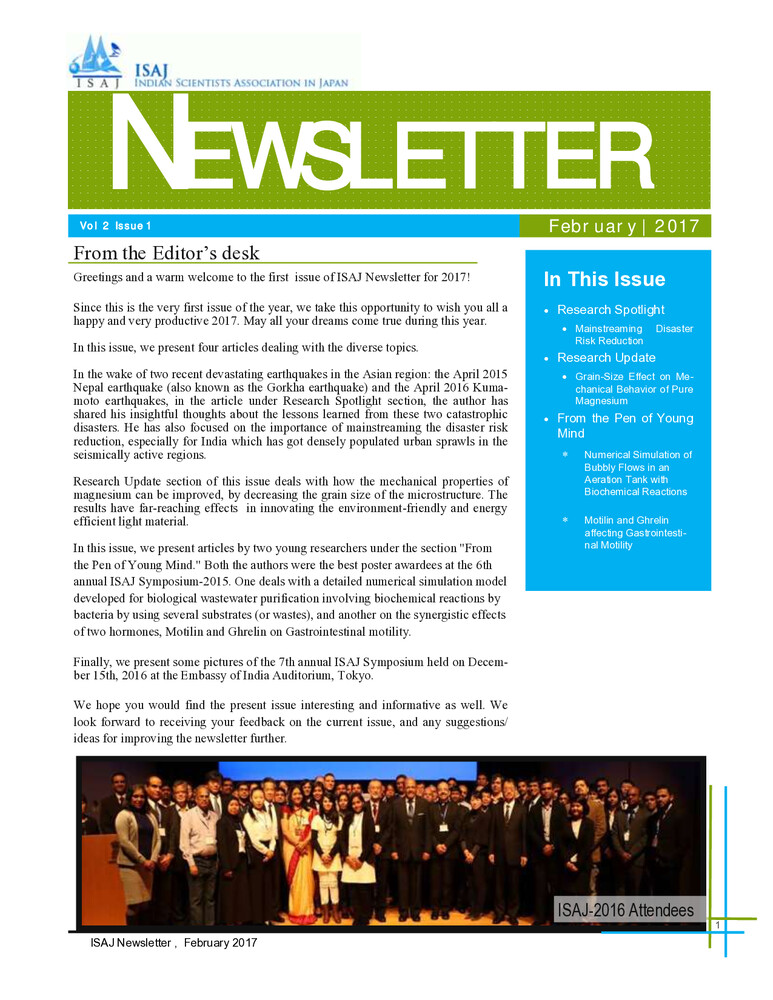
The first issue of 2017 presents critical insights on mainstreaming disaster risk reduction following recent earthquakes in Asia, breakthrough research on improving magnesium mechanical properties through grain refinement, and studies on wastewater treatment and gastrointestinal hormone effects.
Important takeaways and highlights from this issue
Disaster Risk Reduction Lessons.
Critical analysis of Nepal Gorkha (2015) and Kumamoto (2016) earthquakes highlighting vulnerability of brick buildings with mud mortar and need for mainstreaming disaster preparedness in densely populated seismic regions
Magnesium Material Innovation.
50% improvement in yield strength and ductility achieved in pure magnesium through grain refinement to 2.3 μm, advancing lightweight material development for energy-efficient applications
Wastewater Treatment Modeling.
Comprehensive numerical simulation incorporating 14 bacteria types and 50+ substrates for biological wastewater purification using bubble plume systems with biochemical reactions
Gastrointestinal Research.
First report on synergistic effects of motilin and ghrelin hormones on gastric contractions, with proximal stomach identified as most responsive region
7th ISAJ Symposium Success.
Annual symposium held December 15, 2016 at Embassy of India Auditorium, Tokyo, showcasing diverse research and fostering India-Japan scientific collaboration
Article Summaries
Below you'll find condensed summaries from our newsletter articles.
To explore complete research details, figures, and references, view the full newsletter.
From the Editor’s Desk
Greetings and a warm welcome to the first issue of ISAJ Newsletter for 2017!
Since this is the very first issue of the year, we take this opportunity to wish you all a happy and very productive 2017. May all your dreams come true during this year.
In this issue, we present four articles dealing with diverse topics. In the wake of two recent devastating earthquakes in the Asian region: the April 2015 Nepal earthquake (Gorkha earthquake) and the April 2016 Kumamoto earthquakes, we present insightful thoughts about lessons learned from these catastrophic disasters, focusing on the importance of mainstreaming disaster risk reduction, especially for India which has densely populated urban sprawls in seismically active regions.
Research Spotlight: Mainstreaming Disaster Risk Reduction
By Dr. Shanthanu R. Menon, Engineering Consultant, Kozo Keikaku Inc., Tokyo
Nepal suffered heavy damage in 2015 due to the series of earthquakes that struck in and around the Kathmandu Valley (The Gorkha Earthquake). The events reminded the world about the devastating capabilities of natural hazards. The earthquakes exposed the vulnerability of certain building types, particularly brick buildings with mud mortar.
Key Challenges
Research in earthquake engineering faces multiple challenges:
Bridging the Gap: Between academic research and actual practices to provide practical engineering solutions
Learning from Experience: Japan’s abundant experience in tackling natural hazards provides valuable lessons
Mainstreaming Strategy: How to reach out to masses and increase community awareness against natural hazards
India’s Precarious Position
Many regions in India face critical risks:
Densely populated urban sprawls in seismically active regions
Relatively weak building infrastructure
Impending risk of large-scale disaster
The challenge involves not only the research community and bureaucrats but every citizen of the country in building disaster resilience.
Research Update: Grain-Size Effect on Mechanical Behavior of Pure Magnesium
By Mohit Joshi, Kyoto University
Global warming concerns have led to recommendations for using light materials like Aluminum, Magnesium, or polymeric composites for energy-efficient product designs. Magnesium-based alloys are the lightest among structural metallic materials with high strength-to-weight ratio, better heat dissipation, electromagnetic shielding, and recyclability than polymer composites.
Research Findings
To improve mechanical properties of magnesium:
Fine-grained microstructure: Average grain size of 2.3 μm
Coarse-grained microstructure: Average grain size of 7.8 μm
Results: Fine-grained specimens showed 50% improvement in both yield strength and ductility
This breakthrough suggests grain-refinement can be used to improve mechanical properties of other magnesium-based alloys, advancing lightweight structure innovation across automotive, aerospace, and electronics industries.
From the Pen of Young Mind: Numerical Simulation of Bubbly Flows in Aeration Tank
By Khateeb Noor Ul Huda, The University of Tokyo
Research Purpose
Development of a comprehensive model representing wastewater treatment reactor using bubble plume system as the reaction tank, incorporating all biochemical reactions numerically.
Technical Details
Biological Reactions: Aerobic and Anaerobic/Anoxic reactions
System Complexity: 14 different bacteria types and 50+ substrates
Methodology: Activated Sludge system for aerobic reactions, Monod kinetics
Validation: Error between study and model slopes approximately 3.5%
Key Findings
100 μm bubble radius gives best results due to small size and high dissolution
500 μm performs better than 250 μm due to internal circulation
Model successfully represents biological wastewater purification with complex bacterial reactions
From the Pen of Young Mind: Motilin and Ghrelin Affecting Gastrointestinal Motility
By Amrita Dudani, Saitama University
The gastrointestinal tract is the body’s largest endocrine organ. Motilin and Ghrelin hormones comprise a gut peptide hormone family regulating gastrointestinal motility - the movement of the digestive system and transit of contents.
Research Approach
Using Suncus murinus (Asian house shrew) as a model:
Examined fundus, upper corpus, lower corpus, and antrum regions
Conducted in-vitro organ bath experiments
Measured mRNA expression of receptors GPR38 and GHSR
Key Discovery
This is the first report suggesting that the proximal stomach (fundus and upper corpus) is most sensitive and responsive to motilin- and ghrelin-induced synergistic gastric contractions. The findings have potential clinical applications for developing motilin/ghrelin-derived compounds.
7th ISAJ Symposium 2016 Highlights
The 7th Annual ISAJ Symposium was successfully held on December 15, 2016, at the Embassy of India Auditorium, Tokyo. The event featured:
Inaugural lamp lighting ceremony
Multiple poster sessions showcasing cutting-edge research
Interactive tea/coffee breaks for networking
Strong participation from both Indian and Japanese scientific communities
The symposium continued ISAJ’s tradition of fostering collaboration and knowledge exchange between researchers from both nations.
Want to read the complete articles?
Access the full newsletter with detailed research, figures, and references.
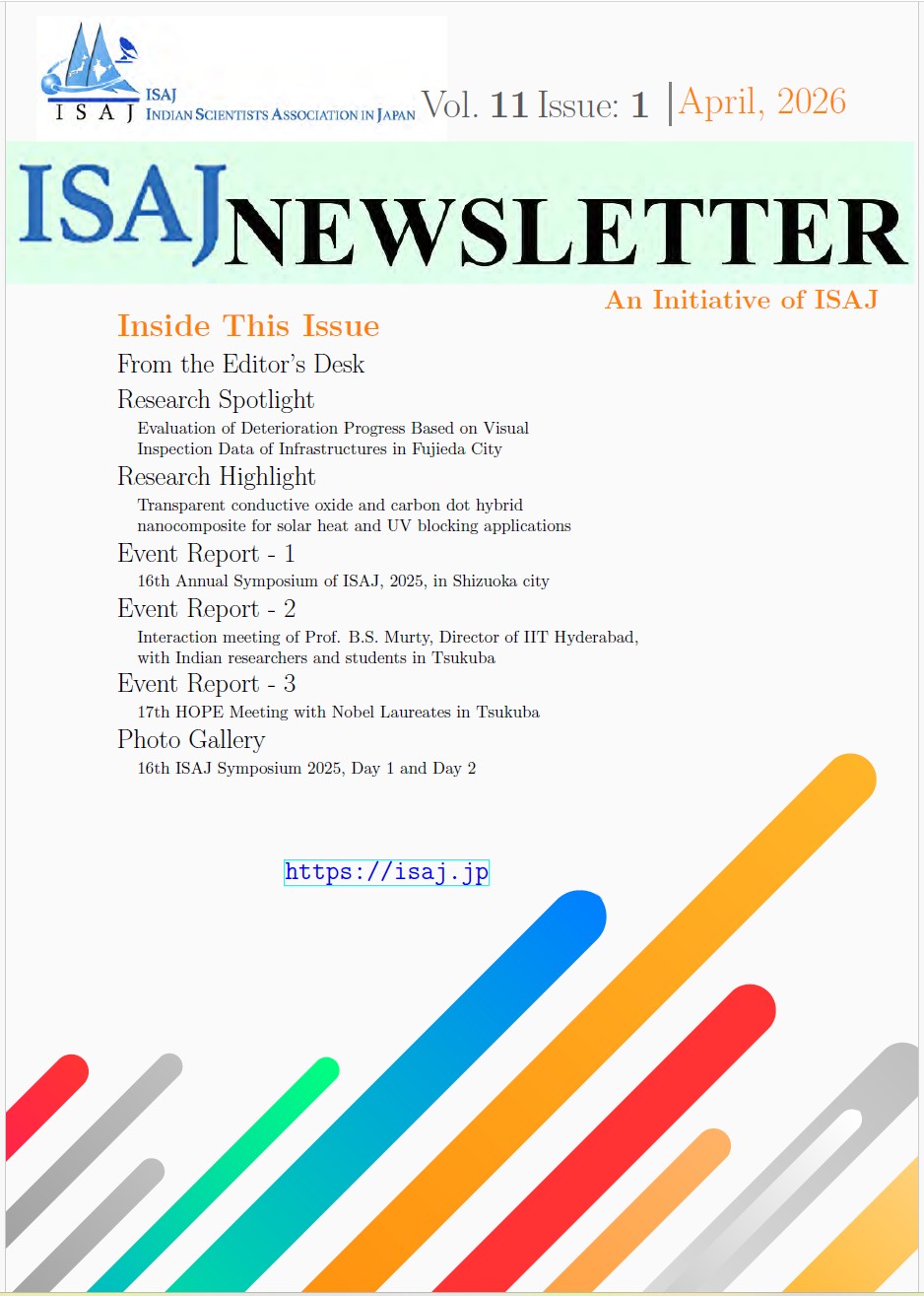
Marks 10 years of ISAJ Newsletter publication, featuring research on bridge deterioration analysis in Fujieda City, transparent conductive oxide and carbon dot nanocomposites for solar heat and UV blocking, and event reports from the 16th ISAJ Symposium, Prof. B.S. Murty's Tsukuba interaction, and the 17th JSPS HOPE Meeting.
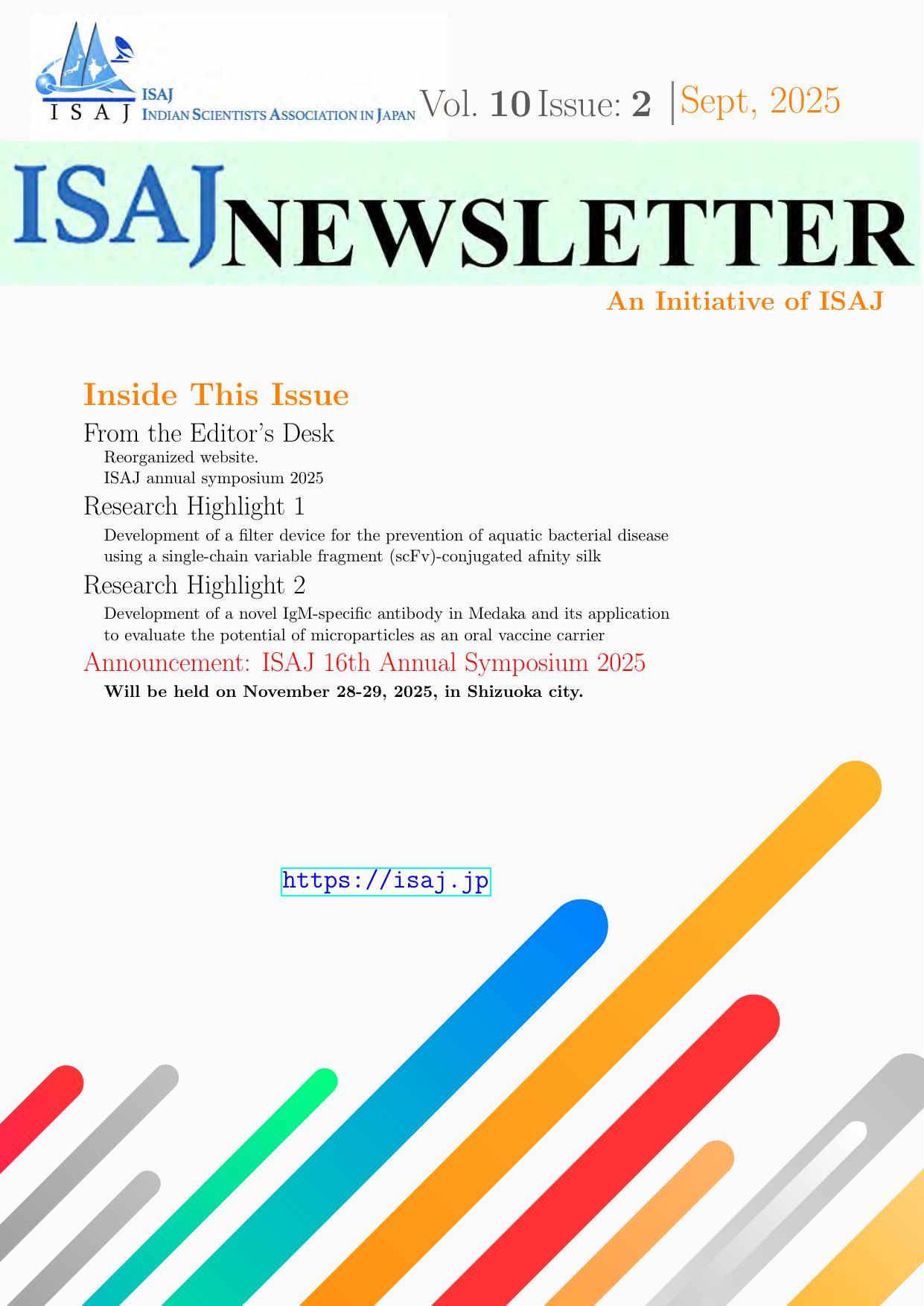
Features research on aquatic bacterial disease prevention using affinity silk filters, IgM-specific antibodies in Medaka for vaccine development, and ISAJ 16th Symposium announcement
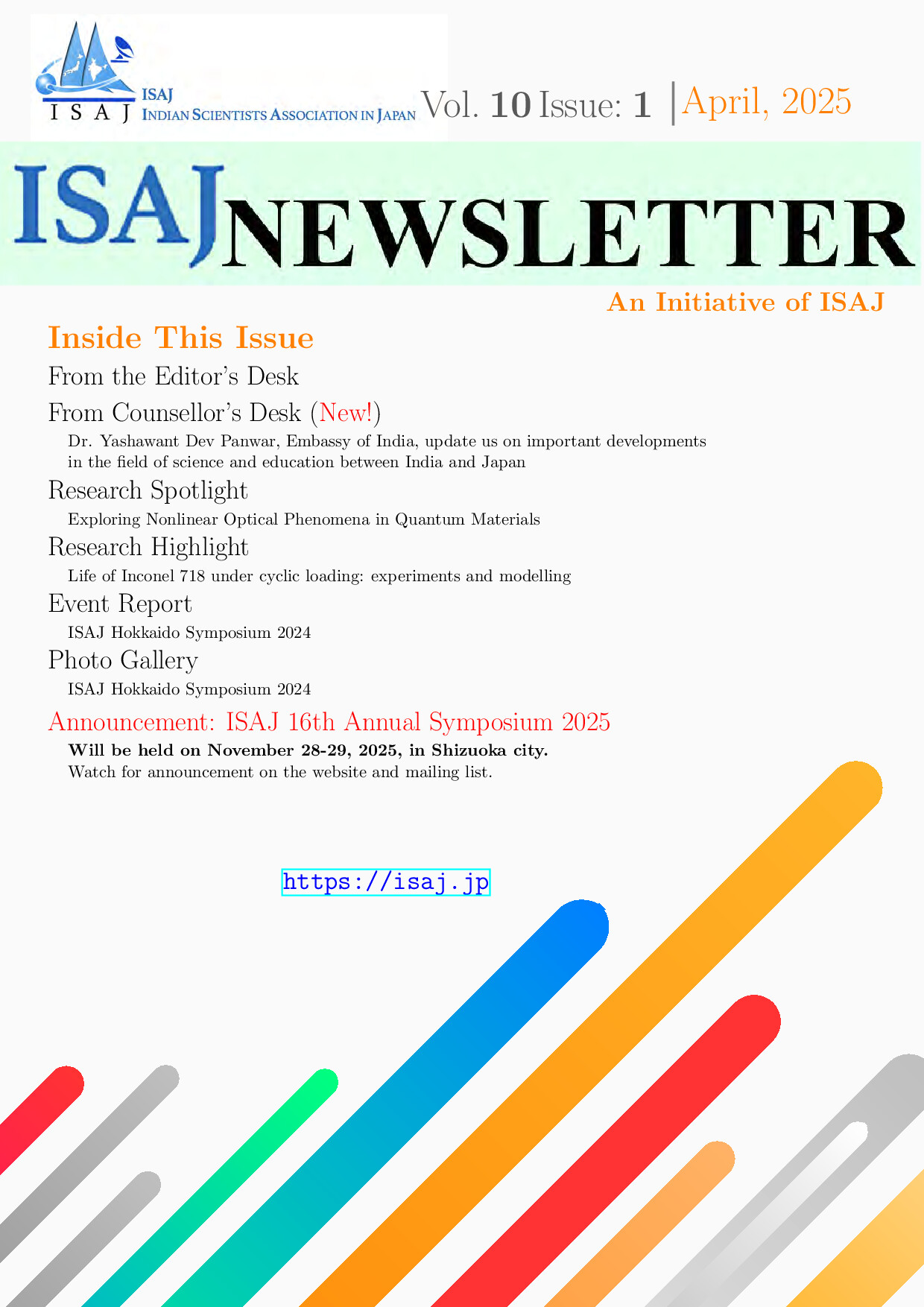
Features India-Japan STI Exchange Year, nonlinear optical phenomena in quantum materials, Inconel 718 fatigue modeling, and ISAJ Hokkaido Symposium 2024
Loading search index
Please wait while we prepare search...
No results found
We couldn't find anything with that term. Please
try again.