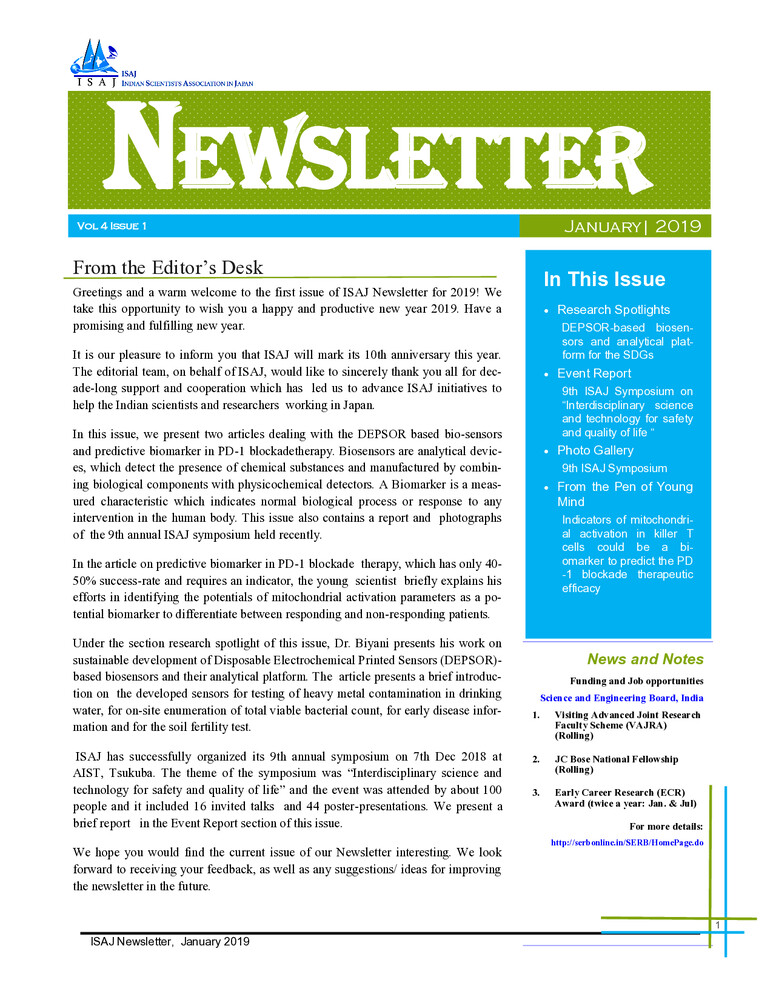
The January 2019 issue marks ISAJ's 10th anniversary year, presenting innovative biosensor platforms for sustainable development goals, breakthrough research on PD-1 blockade therapy biomarkers, and a comprehensive report from the 9th ISAJ Annual Symposium held at AIST Tsukuba.
Important takeaways and highlights from this issue
ISAJ 10th Anniversary.
ISAJ marks its 10th anniversary in 2019, celebrating a decade of fostering India-Japan scientific collaboration and supporting Indian researchers in Japan
DEPSOR Biosensor Platform.
Revolutionary portable electrochemical sensors for heavy metal detection, bacterial count, disease biomarkers, and soil fertility testing supporting UN SDGs
Cancer Immunotherapy Biomarker.
Mitochondrial activation parameters in CD8+ T cells identified as potential biomarkers to predict PD-1 blockade therapy response with 40-50% success rate
9th ISAJ Symposium Success.
100 participants, 16 invited talks, and 44 posters on interdisciplinary science for safety and quality of life at AIST Tsukuba
Nobel Prize Connection.
Young Indian researchers from Prof. Tasuku Honjo's laboratory (2018 Nobel Laureate in Medicine) participated in the symposium
Article Summaries
Below you'll find condensed summaries from our newsletter articles.
To explore complete research details, figures, and references, view the full newsletter.
From the Editor’s Desk
Greetings and a warm welcome to the first issue of ISAJ Newsletter for 2019! We take this opportunity to wish you a happy and productive new year 2019.
It is our pleasure to inform you that ISAJ will mark its 10th anniversary this year. The editorial team, on behalf of ISAJ, would like to sincerely thank you all for decade-long support and cooperation which has led us to advance ISAJ initiatives to help the Indian scientists and researchers working in Japan.
In this issue, we present two articles dealing with DEPSOR-based biosensors and predictive biomarker in PD-1 blockade therapy. Biosensors are analytical devices which detect the presence of chemical substances and manufactured by combining biological components with physicochemical detectors. A Biomarker is a measured characteristic which indicates normal biological process or response to any intervention in the human body.
Research Spotlight: DEPSOR-Based Biosensors and Analytical Platform for the SDGs
By Dr. Manish Biyani, Associate Professor, JAIST
Technological innovation is key to the implementation of Sustainable Development Goals (SDGs) set by United Nations. We describe a robust and handheld device, called DEPSOR (Disposable Electrochemical Printed Sensor), for rapid and affordable electrochemical sensing of analytes.
System Components
The unique combination of:
Hardware: Disposable electrode printed chip and palm-sized potentiostat
Software: Smartphone-supported programming for on-site voltammetry analysis
These elements make the system extremely portable and affordable with application-ready signal outputs in resource-limited settings.
DEPSOR Platform Series
A series of DEPSOR platforms has been developed:
DEPSOR-M: Rapid and simultaneous testing of multiple heavy metals (arsenic, cadmium, mercury, lead) at ppb levels
DEPSOR-V: On-site enumeration of total viable bacterial count in milk and food samples below WHO permissible range
DEPSOR-H: Aptamer-based sensing of early disease information for CVD, Cancer, Alzheimer’s disease
DEPSOR-N: Farmer-friendly and on-site soil fertility testing
With these diverse applications, DEPSOR is highly expected to bring rapid transformation of electrochemical sensing technologies for mass application and solutions for sustainable development challenges.
Recognition
Recently, Dr. Biyani has been felicitated by the Japan Foreign Ministry with Commendation award in recognition of his key role in promoting grass-root level people-to-people exchange between Japan and India.
Event Report: 9th ISAJ Annual Symposium
The Indian Scientists Association in Japan organized its 9th annual symposium on “Interdisciplinary science and technology for safety and quality of life” at the National Institute of Advanced Industrial Science and Technology (AIST) auditorium in Tsukuba Science City on December 7, 2018.
Opening Session
The symposium began with:
Welcome address by Chairman Dr. Sunil Kaul
Inspiring addresses from Dr. Katsunori Matsuoka (AIST Vice-President) and Mr. Raj Kumar Srivastava (Chargé d’affaires, Embassy of India)
Both stressed the need, progress, and global influence of India-Japan relationship for mutual benefit and targeting global issues
Scientific Program
16 invited talks by senior and young scientists (20 minutes each)
Special session: 7 selected students presented doctoral research (10 minutes each)
44 poster presentations providing ample opportunities for young researchers
Topics covered: biology and medicine, power and structural engineering, energy and environment
Participation
100 participants from broad range of disciplines
Attendees from as far as Kyoto and Sendai
Representatives from academia, industry, and national laboratories
Some young researchers represented laboratory of 2018 Nobel Laureate Prof. Tasuku Honjo (Kyoto University)
Awards
Best poster presentation awards were given to:
Ms. Manpreet Kaur (NIMS)
Ms. Madhu Malinee (Kyoto University)
Mr. Vaibhav Mehta (Yokohama International University)
Ms. Jia Wang (AIST)
From the Pen of Young Mind: Mitochondrial Activation as PD-1 Therapy Biomarker
By Alok Kumar, Kyoto University
Cancer is the leading cause of morbidity and mortality worldwide. Immunotherapy by PD-1 blockade has given revolutionary impact in cancer treatments with durable effect and high efficacy against wide variety of cancers with limited side-effects compared to traditional therapy.
The Challenge
However, around 40-50% of patients remain unresponsive to PD-1 blockade therapy. Consequently, effort has focused on identification of biomarkers that can distinguish between responders and non-responders at treatment initiation to save precious time, laborious efforts, and costs.
Research Hypothesis
We hypothesized that mitochondrial activation parameters could serve as potential biomarkers to differentiate responding and non-responding patients, since:
CD8+ T cells are major effector cells in tumor rejection
They are dysfunctional in unresponsive tumors
Mitochondrial energy metabolism regulates T cell differentiation
Key Findings
We measured oxygen consumption rate (OCR) of CD8+ T cells in:
Responsive tumors (MC38, colon carcinoma): Higher OCR in treated group
T-bet (transcription factor for T cell killer function)
All parameters were higher in effector T cells of responsive tumor-bearing hosts compared to unresponsive group, with similar results across different genetic backgrounds (C57BL/6N and BALB/c).
Clinical Implications
Based on initial findings in mice, mitochondrial activation parameters will serve as potential biomarkers to differentiate responders and non-responders to PD-1 blockade therapy.
Funding Opportunities
Science and Engineering Research Board, India
Visiting Advanced Joint Research Faculty Scheme (VAJRA) - Rolling
JC Bose National Fellowship - Rolling
Early Career Research (ECR) Award - Twice a year (January & July)
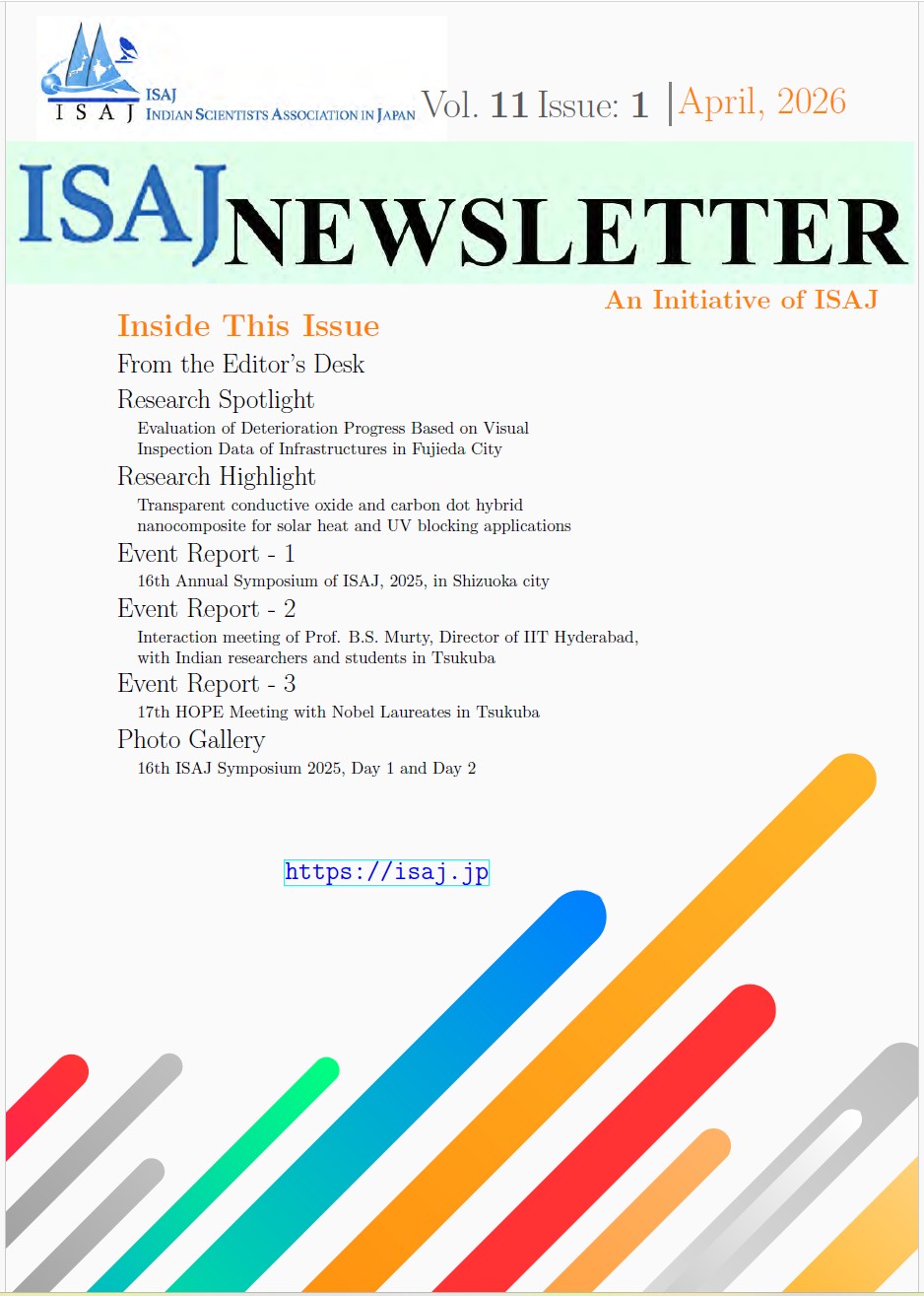
Marks 10 years of ISAJ Newsletter publication, featuring research on bridge deterioration analysis in Fujieda City, transparent conductive oxide and carbon dot nanocomposites for solar heat and UV blocking, and event reports from the 16th ISAJ Symposium, Prof. B.S. Murty's Tsukuba interaction, and the 17th JSPS HOPE Meeting.
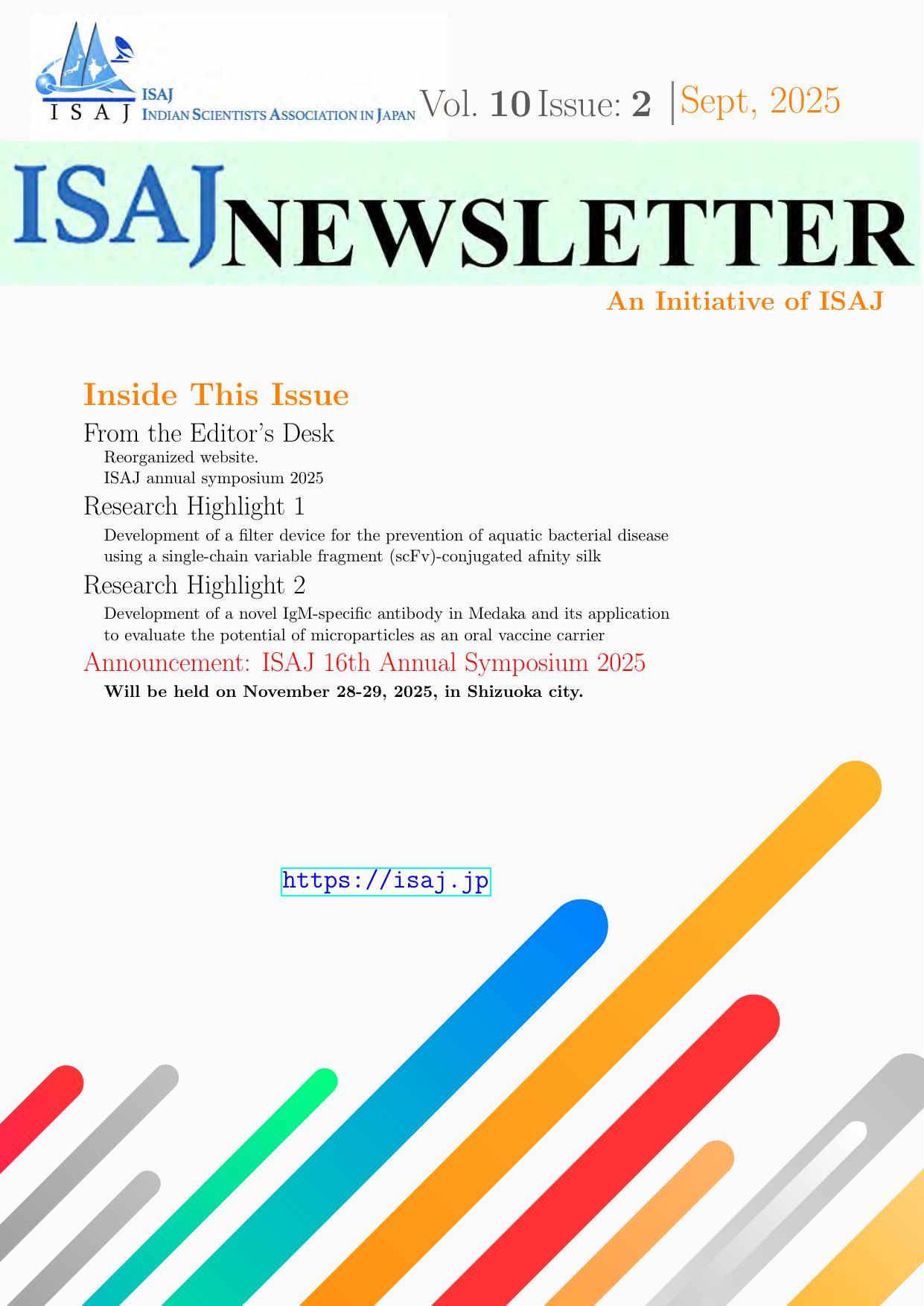
Features research on aquatic bacterial disease prevention using affinity silk filters, IgM-specific antibodies in Medaka for vaccine development, and ISAJ 16th Symposium announcement
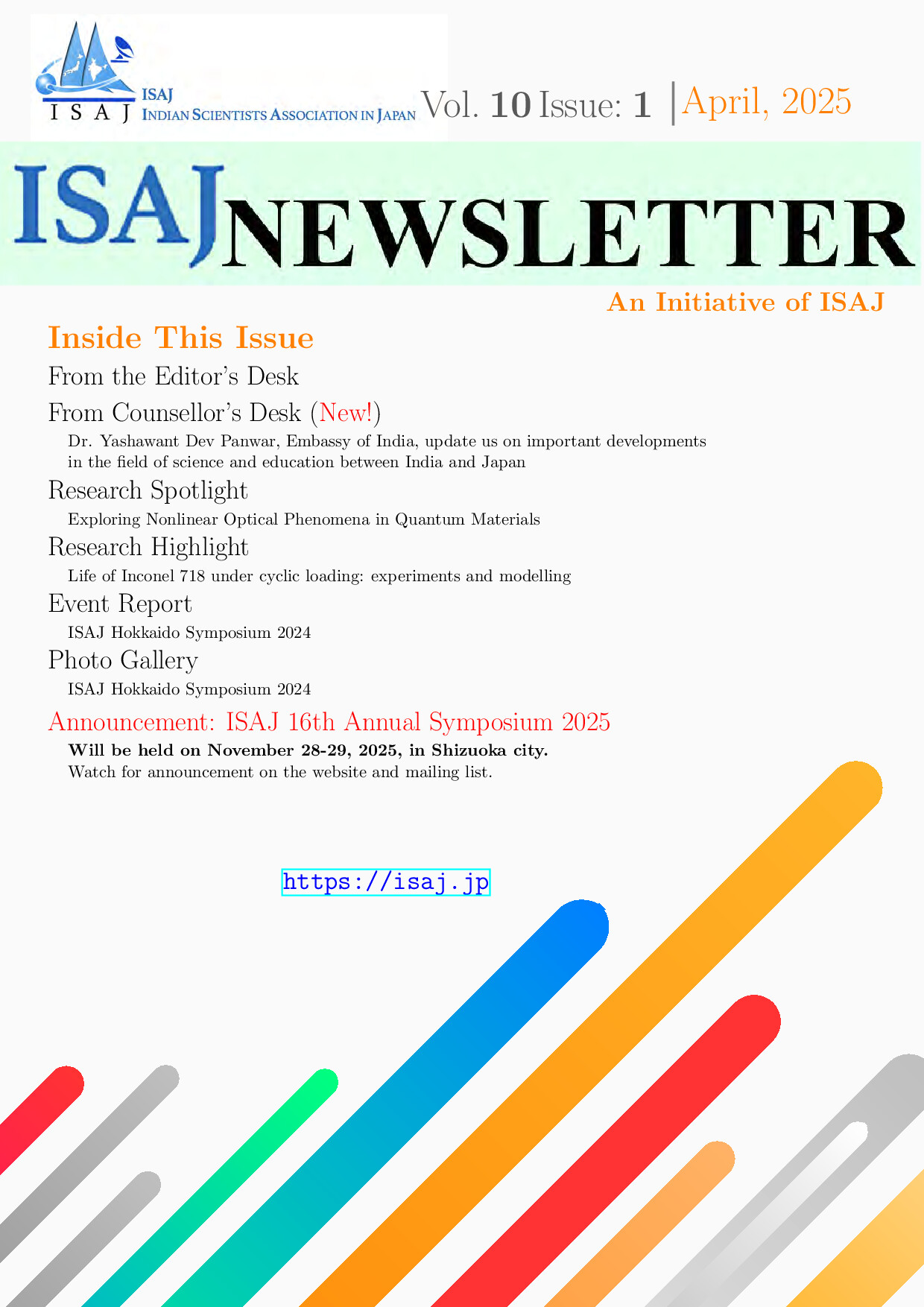
Features India-Japan STI Exchange Year, nonlinear optical phenomena in quantum materials, Inconel 718 fatigue modeling, and ISAJ Hokkaido Symposium 2024
Loading search index
Please wait while we prepare search...
No results found
We couldn't find anything with that term. Please
try again.