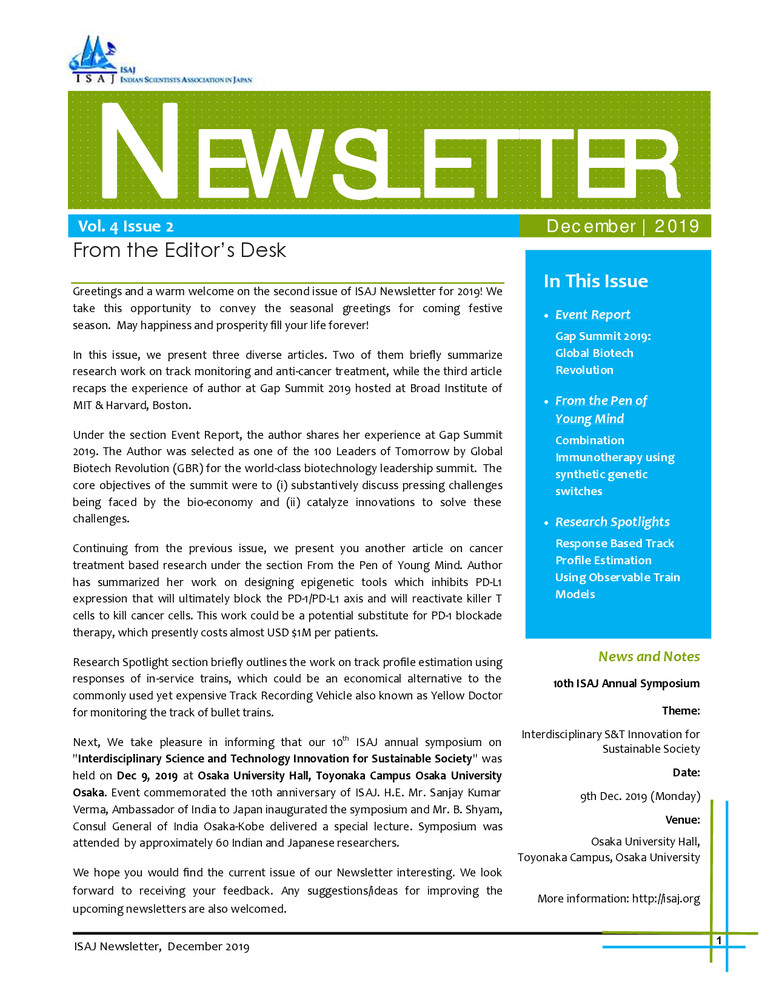
The December 2019 issue presents insights from the Global Biotech Revolution Gap Summit at MIT, breakthrough research on synthetic genetic switches for cancer immunotherapy, and innovative railway track monitoring using observable train models.
Important takeaways and highlights from this issue
10th ISAJ Anniversary Symposium.
Commemorated ISAJ's 10th anniversary at Osaka University with H.E. Mr. Sanjay Kumar Verma, Ambassador of India to Japan, and 60 participants
Gap Summit 2019 Excellence.
ISAJ member selected as one of 100 Leaders of Tomorrow from 44 countries at Global Biotech Revolution summit at MIT & Harvard
Cost-Effective Cancer Therapy.
Designer PIPs developed as alternative to expensive PD-1 blockade therapy (USD $1M per patient) using synthetic genetic switches
Railway Safety Innovation.
Novel track profile estimation system using in-service trains as economical alternative to expensive Track Recording Vehicles
Global Bioeconomy Focus.
Summit addressed critical gaps in R&D productivity, AI in healthcare, biosecurity, and sustainable healthcare economics
Article Summaries
Below you'll find condensed summaries from our newsletter articles.
To explore complete research details, figures, and references, view the full newsletter.
From the Editor’s Desk
Greetings and a warm welcome on the second issue of ISAJ Newsletter for 2019! We take this opportunity to convey the seasonal greetings for coming festive season. May happiness and prosperity fill your life forever!
In this issue, we present three diverse articles. Two of them briefly summarize research work on track monitoring and anti-cancer treatment, while the third article recaps the experience at Gap Summit 2019 hosted at Broad Institute of MIT & Harvard, Boston.
We take pleasure in informing that our 10th ISAJ annual symposium on “Interdisciplinary Science and Technology Innovation for Sustainable Society” was held on December 9, 2019 at Osaka University Hall, Toyonaka Campus. The event commemorated the 10th anniversary of ISAJ. H.E. Mr. Sanjay Kumar Verma, Ambassador of India to Japan inaugurated the symposium and Mr. B. Shyam, Consul General of India Osaka-Kobe delivered a special lecture. The symposium was attended by approximately 60 Indian and Japanese researchers.
Event Report: Gap Summit 2019 - Global Biotech Revolution
By Ankita Jain, Business Development Associate, Healios K.K.
I was selected as one of the 100 Leaders of Tomorrow by Global Biotech Revolution (GBR) for the world-class biotechnology leadership summit held June 16-20, 2019 at Kendall Square, Cambridge, MA.
Summit Themes and Challenges
The aim of the Gap summit is to bring together different stakeholders ranging from academia to industry and from NGOs to international organizations, to discuss and solve the different ‘gaps’ in the global biotech ecosystem. Themes for this year revolved around:
R&D Productivity: Reducing high failure rates in pharmaceutical product development
Bench to Market: Making technology transfer a more seamless process
AI & Digital Health: Impact of deep-tech penetration in biotech industry
Biosecurity & Bioethics: Incentivizing stakeholders for global policy making
Sustainable Healthcare Economics: Providing accessible healthcare with aging populations
Sustainability & Agri-Tech: Biotech solutions for feeding growing populations
Global Bioeconomies: Democratizing the biotechnology industry
Key Highlights
The 5-day summit kicked off with introductory remarks by Dr. Tedros Adhanom, Director General, World Health Organization. This was followed by panel discussions featuring representatives from:
Leading pharma companies: Novartis, Biogen, Bayer
Global organizations: World Bank, Bill & Melinda Gates Foundation
Eminent academicians: Prof. Phillip Sharp, Nobel Laureate, MIT
Bio-Innovation Competition
The 100 Leaders participated in a 4-month long Bio-Innovation Competition. I collaborated with 4 other leaders from Denmark, UK & US. Under mentorship from Johnson & Johnson R&D leaders, we developed a digital solution for providing first-line screening for women’s fertility health. Selected teams received initial seed-funding and mentorship to build biotech startups.
Key Takeaways
Convergence, Consensus & Coordination - More interdisciplinary teams will be needed to collaborate and co-develop innovative solutions for addressing both present and future challenges.
From the Pen of Young Mind: Combination Immunotherapy Using Synthetic Genetic Switches
By Madhu Malinee, Kyoto University
Cancer is the second most leading cause of deaths worldwide. The number of new cancer cases per year is expected to rise to 23.6 million by 2030. While chemotherapy is the most preferred treatment, toxic side effects and resistance warrant alternative strategies.
The Challenge
The interaction of programmed cell death protein 1 (PD-1) and its ligand (PD-L1) causes T cell inhibition, thereby inhibiting anti-tumor immunity. U.S. FDA has approved anti-PD-1 or anti-PD-L1 antibodies for many cancers. However, the high cost of PD-1 blockade therapy (approx. USD $1M per patient per year) restricts its worldwide application, considering 70% of cancer patients are from developing countries.
Our Innovation
We have developed designer PIPs (N-Methylpyrrole and N-methylimidazole hairpin polyamides) as a cost-effective combinatorial approach:
Genetic OFF Switches: Chb-PIP conjugate to ‘Switch OFF’ PD-L1 expression in cancer cells
Genetic ON Switches: PIPs conjugated with epigenetic activator CTB to induce transcription factors for mitochondrial activation
Results
We synthesized Chb-PIPs that selectively switch OFF PD-L1 gene expression:
PD-L1 expression inhibited at transcript level (qPCR analysis)
PD-L1 suppression confirmed at protein level (flow cytometry)
Currently screening PIPs for upregulation of mitochondrial biogenesis mediated by PGC-1α
These initial findings pave the way for development of cost-effective PD-1 blockade therapy to benefit more cancer patients globally.
Research Spotlight: Response Based Track Profile Estimation Using Observable Train Models
By Dr. T. Jothi Saravanan, JSPS Postdoctoral Fellow, Yokohama National University
Local railway networks suffer from age-related deterioration and poor maintenance. Track profile, which directly influences ride quality and safety, needs to be estimated for maintenance purposes.
Current Challenges
Currently, Track Recording Vehicles (TRV) such as Doctor Yellow in Japan are utilized for track condition monitoring. However, TRVs are:
Expensive to operate
Cannot be frequently used for local railway lines
Used only once a year for most lines
Proposed Solution
We have developed a robust inverse analysis scheme for track geometry estimation from local in-service train responses:
Extended Augmented State Kalman Filter (ASKF): Solved the Observability Rank Condition for state space model
Sensor Optimization: Theoretically obtained appropriate sensor types and placements
Multi-Body Simulations: Used SIMPACK to investigate different factors and validate algorithm
Key Achievements
Vertical Track Profile: Good agreement for straight track sections
Lateral Track Profile: Can estimate wavelengths above 8m
Practical Implementation: Uses accelerometer and gyroscope mounted on car body floor and bogie mass
Validation: Tested on experimental measurements from in-service local railway lines
Impact
This system provides:
Cost-effective alternative to expensive TRVs
More frequent monitoring capability
Real-time track condition assessment
Enhanced safety for local railway networks
The proposed approach enables efficient and frequent track monitoring using regular in-service trains, potentially transforming railway maintenance practices.
10th Anniversary Symposium
The 10th ISAJ Annual Symposium on “Interdisciplinary Science and Technology Innovation for Sustainable Society” was successfully held on December 9, 2019 at Osaka University Hall. This milestone event commemorated ISAJ’s decade of fostering India-Japan scientific collaboration.
Want to read the complete articles?
Access the full newsletter with detailed research, figures, and references.
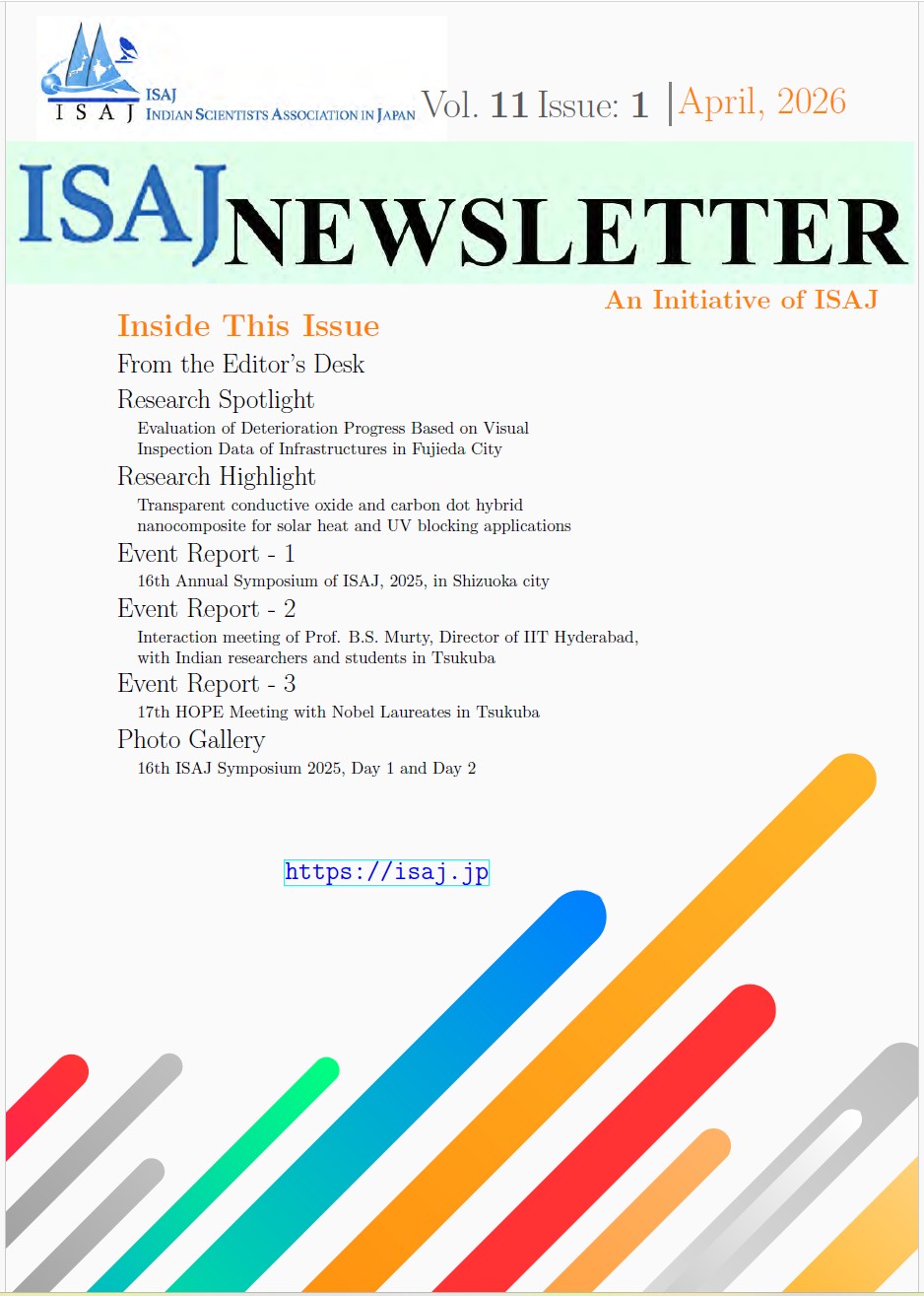
Marks 10 years of ISAJ Newsletter publication, featuring research on bridge deterioration analysis in Fujieda City, transparent conductive oxide and carbon dot nanocomposites for solar heat and UV blocking, and event reports from the 16th ISAJ Symposium, Prof. B.S. Murty's Tsukuba interaction, and the 17th JSPS HOPE Meeting.
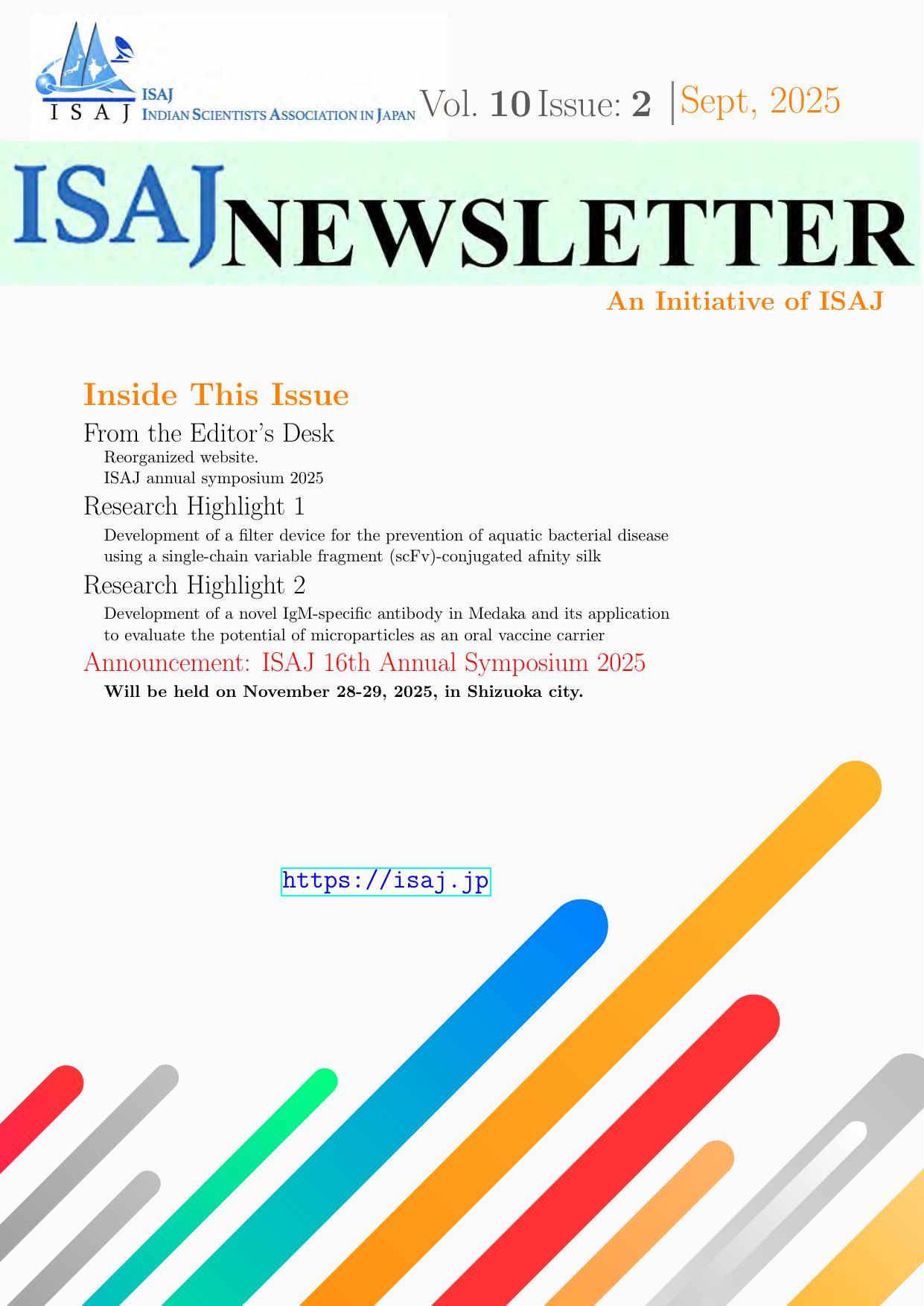
Features research on aquatic bacterial disease prevention using affinity silk filters, IgM-specific antibodies in Medaka for vaccine development, and ISAJ 16th Symposium announcement
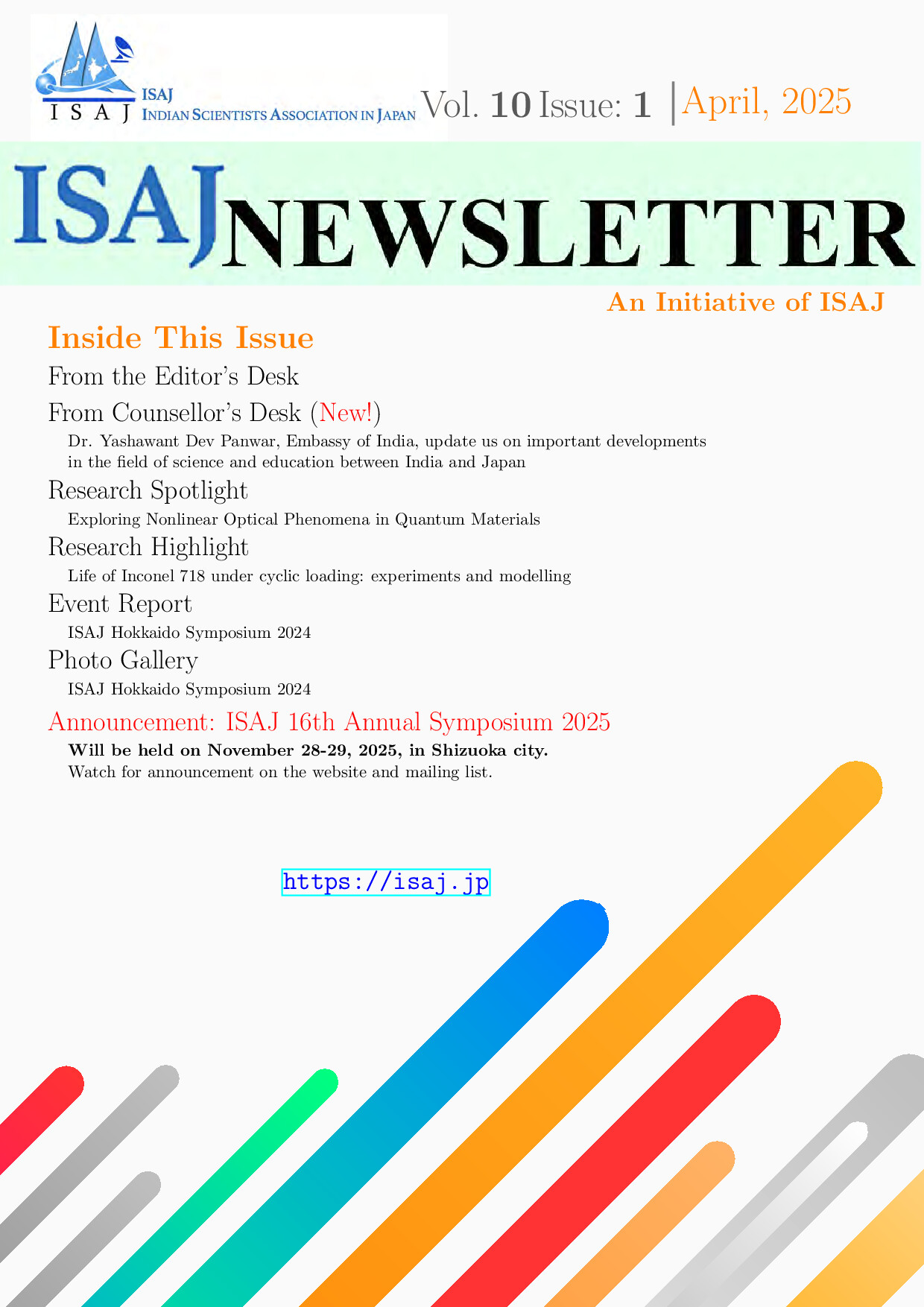
Features India-Japan STI Exchange Year, nonlinear optical phenomena in quantum materials, Inconel 718 fatigue modeling, and ISAJ Hokkaido Symposium 2024
Loading search index
Please wait while we prepare search...
No results found
We couldn't find anything with that term. Please
try again.