From the Editors’ Desk
Greetings and a warm welcome to the first issue of ISAJ Newsletter for 2020! We take this opportunity to wish you a healthy life and hope that you are taking all necessary precautions amid COVID-19 pandemic.
It is our pleasure to inform you that the ISAJ newsletter has marked its 5th anniversary this year. On behalf of ISAJ, we, the editorial team of the newsletter, would like to sincerely thank you all our readers for your support and cooperation, which has been instrumental in pursuing our goal to keep the ISAJ community informed of ISAJ activities and to offer substantial information on the achievements of its community members.
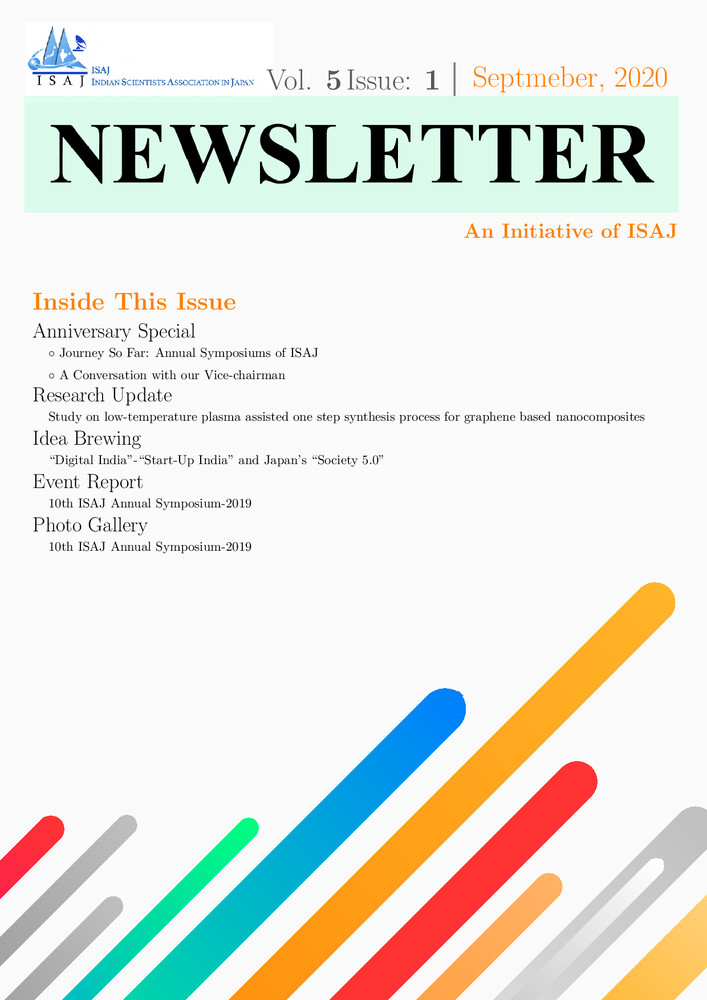
In this special issue, we present an activity report, “Journey So Far,” dealing with all ten annual symposia which ISAJ organized since its formation in 2009, to provide historical perspective. We also present our conversation with Dr. Alok Singh, Vice Chairman, ISAJ, to understand his perspective on the organization’s evolution and potential for future growth.
Anniversary Special: Journey So Far - Annual ISAJ Symposia
Formally inaugurated in 2009, ISAJ is now over ten years old and held its 10th annual symposium on science and technology last year. On reaching this milestone, it is time to look back on those ten years.
Features, Evolution and Milestones
The annual symposium has been the most important annual event of ISAJ. Prominent professors and scientists from all disciplines of science and technology are invited to talk about the current state of knowledge, and young researchers present their recent work in oral as well as poster sessions. Participation is open to Indian and Japanese researchers, as well as of any other nationality working in Japan.
The poster session is the liveliest part of the symposium, showcasing the latest research by young researchers in Japan. There are awards for the best poster presentations. Abstracts of all presentations are published in an abstracts book distributed to all participants and made available for download from the ISAJ website.
Timeline of 10 Years
1st Symposium (2010): “India-Japan Symposium on Emerging Technologies”
- Convened by Dr. Sunil Kaul and Dr. Kedar Mahapatra
- Inaugurated by Hon. Shri Prithviraj Chavan, S&T Minister of India
- 91 presentations including 11 plenary lectures
2nd Symposium (2011): “Global Challenges in Health and Environment”
- Dedicated to 2011 Great Tohoku Earthquake and Tsunami victims
- Keynote by Prof. Kiyoshi Kurokawa, former head of Japan Science Council
- 51 poster presentations
3rd Symposium (2012): “Frontiers in Science & Technology”
- Marked 60 years of India-Japan diplomatic relations
- Extended to two days for the first time
- Addressed by multiple dignitaries including JSPS President Dr. Yuichiro Anzai
4th-6th Symposiums (2013-2015): Evolution of themes from “Emerging Materials” to “Recent Advances in Science and Technology”
- Introduction of Students and Young PI Sessions
- Multidisciplinary plenary sessions to foster inter-disciplinary collaborations
7th Symposium (2016): “Science and Technology for Sustainability”
- Joint organization with JSPS-DST Asia Academic Seminar 2016
- 20 Indian scientists from top institutions (IITs, IISc, IACS) participated
8th Symposium (2017): “Bridging Nature and Technology”
- First time at University of Tokyo, Hongo campus
- All organizing team members were young researchers
9th Symposium (2018): First time in Tsukuba Science City
- 100 participants including researchers from 2018 Nobel Laureate Prof. Tasuku Honjo’s lab
10th Symposium (2019): First time in Kansai region (Osaka)
- Commemorated ISAJ’s 10th Anniversary
- Support from Ambassador and Consul General
Anniversary Special: A Conversation with Dr. Alok Singh, Vice Chairman, ISAJ
Chief Researcher, NIMS, Tsukuba
“In 2008, the then S&T counselor Dr. Pankajakshan took the initiative to form this association and invited some of us living in and around Tokyo for brainstorming sessions at his home many times. In those sessions, ISAJ was conceived, structured, and formally inaugurated by Prof. Chidambaram, Principal Scientific Adviser to Government of India on January 19, 2009.”
On 10th Anniversary Reflections
“All these years are a wonderful memory now. The various times and situations, various people we worked with while organizing the annual symposium. We have come a long way, learning, correcting our course, and changing with the situation. We made contact and were honored by many academics in Japan by their talks in the symposium.”
On Challenges Overcome
Financial Constraints: “We had conceived the association to be membership subscription-based. It did not work out that way. For the first several years, executive members contributed 50,000 Yen each by becoming life members, which made us survive during a critical period.”
Participation Constraints: “We realized that our community members could not participate just by their own motivation. They need permission from their supervisors. Therefore, we started approaching university professors and research institute researchers directly.”
On Biggest Accomplishments
“Our symposium is our biggest showcase, where our community comes together to show what research we are doing in Japan. We are all working in very diverse fields and with various educational backgrounds. That makes a significant impact on government agencies and educational communities.”
Advice to Young Researchers
“Follow your passion and dreams and take life as it comes, because the new world offers many more opportunities for all kinds of talents. Immerse yourselves in the culture of Japan. Examine critically the work culture, the ethical values, the governance, place of religion in society, how to conduct ourselves during a disaster.”
Research Spotlight: Low-Temperature Plasma Assisted Graphene Nanocomposite Synthesis
By Dr. Ranjit R. Borude, Nagoya University
Innovation in Nanocomposite Synthesis
Tin oxide (SnO₂) nanoparticles (SNp) are widely used for gas sensing and as electrodes for lithium-ion batteries but have issues with high-temperature requirements and pulverization. The incorporation of graphene nanosheets (GNs) with SnO₂ overcomes these issues.
Novel Synthesis Method
We developed a one-step synthesis process using in-liquid plasma method:
- Process Conditions: Atmospheric pressure at room temperature
- Single Precursor: Tin chloride in ethanol solution
- No Multiple Steps: Avoids traditional multistep processing
Key Findings
- Uniform Distribution: TEM observations showed 2-3 nm SNp uniformly distributed on both sides of GNs
- Chemical Analysis: FTIR and XPS revealed carboxyl and hydroxyl groups as starting points for composite formation
- Controllable Process: Size and distribution controlled by precursor concentration
- Applications: Suitable for gas-sensing and lithium-ion battery applications
The developed synthesis route is facile and low-cost, offering significant advantages over traditional methods requiring low pressure and high temperature.
Idea Brewing: “Digital India”-“Start-Up India” and Japan’s “Society 5.0”
By Dr. Saichandrateja Radhapuram, KIOXIA Corporation
Society 5.0 Overview
Society 5.0 is a human-centered society achieving both economic development and solution of social issues through highly integrated system of cyber space and physical space. Its elements include:
- IoT sensors
- Big Data
- Artificial Intelligence (AI)
- Robotics (Automation)
Convergence Opportunities
Negotiation Front: Indians need to be upfront about being global leader in providing software solutions, capitalizing on technical manpower availability - a solution for Japan’s aging population challenge.
Legal Front: Need for special policy on export control regulations understanding between India and Japan, similar to Bilateral Patent Prosecution Highway (PPH) programme.
Technology Front Solutions:
- Big Data: Utilizing AWS and GCP platforms for secure data sharing and analytics
- AI: Addressing software (India) and hardware (Japan) seamless integration
- Automation: Amalgamation of Japanese Just-In-Time and ‘Kaizen’ with Indian ‘Jugaad’ for innovation
- Human Resource: Extending awareness beyond Tier-I universities to Tier-II institutions
Conclusion
“Indian Jugaad and Japan’s meticulously detail-oriented mindset would foster innovation which would address the issues of the world.”
Event Report: 10th ISAJ Annual Symposium 2019
The 10th annual ISAJ Symposium “Interdisciplinary Science and Technology Innovations for Sustainable Society” was held on December 9, 2019, at Osaka University Hall, commemorating ISAJ’s 10th Anniversary.
Highlights
- Inaugurated by H.E. Mr. Sanjay Kumar Verma, Ambassador of India to Japan
- Special address by H.E. B. Shyam, Consul General of India, Osaka-Kobe
- 60 participants from across Japan
- 2 keynote lectures, 4 plenary talks, 8 invited lectures
- 15 poster presentations
- Three-minute thesis challenge for young researchers
Awards
- Best Presentation: Ms. Madhu Malini (Kyoto University)
- Best Poster: Trishit Banerjee (Tohoku University)
- Three-minute Thesis: Alok Kumar and Nikesh Narang (Kyoto and Osaka Universities)
Looking Forward
The COVID-19 pandemic has intervened in 2020, but it comes as an opportunity to organize this year’s symposium on the web, which will remove physical distances. ISAJ hopes to organize symposiums in both Kanto (Tokyo) and Kansai regions every year, with younger generation taking things to newer heights.