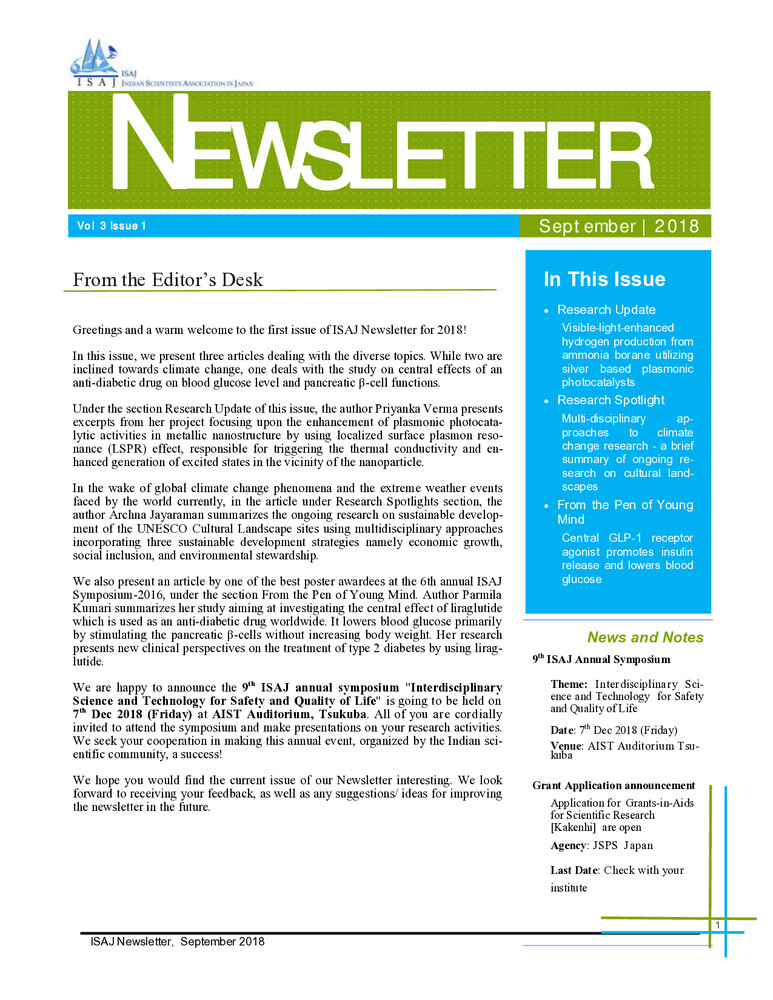
From the Editor’s Desk
Greetings and a warm welcome to the first issue of ISAJ Newsletter for 2018!
In this issue, we present three articles dealing with diverse topics. While two are inclined towards climate change, one deals with the study on central effects of an anti-diabetic drug on blood glucose level and pancreatic β-cell functions.
We are happy to announce the 9th ISAJ annual symposium “Interdisciplinary Science and Technology for Safety and Quality of Life” is going to be held on 7th December 2018 (Friday) at AIST Auditorium, Tsukuba. All of you are cordially invited to attend the symposium and make presentations on your research activities.
Research Update: Visible-Light-Enhanced Hydrogen Production from Ammonia Borane
By Dr. Priyanka Verma, Osaka University
The proliferation of greenhouse gas emissions and climatic changes create an urgency to replace fossil fuels with clean and renewable energy sources. An abundant and reliable source of solar energy is receiving immense interest to solve the problem of increasing energy demands and environmental concerns.
Plasmonic Photocatalysis
Metallic nanostructures such as gold, silver or copper not only have interesting physical properties and lively colors but can also absorb specific visible and infrared light owing to the localized surface plasmon resonance (LSPR) effect. This light-responsive process can trigger thermal conductivity and enhanced generation of excited states in the vicinity of the nanoparticle.
Research Methodology
We describe a method for the synthesis of Ag NPs, the color of which can be altered by changing the size and morphology. This method involves:
- Microwave heating
- Use of SBA-15 mesoporous silica material
- Control of size and morphology to achieve different colors (yellow, red, blue)
Key Findings
The localized surface charge of these Ag NPs resulted in enhanced catalytic activity under visible light irradiation:
- Enhancement was dependent on morphology and color of Ag NPs
- Blue nanorod structures showed highest catalytic activity
- Order of catalytic activity correlated with Ag-LSPR absorption intensity
- All catalysts showed specifically enhanced activities under light irradiation
Future Applications
Plasmonic photocatalysis will play important roles in:
- Air cleaning
- Water splitting
- CO₂ reduction
- Solar to chemical energy conversion
Major advancements are needed for mechanistic pathway understanding, theoretical predictive models (FDTD simulations), and new synthetic strategies.
Research Spotlight: Multi-Disciplinary Approaches to Climate Change Research
By Ms. Archna Jayaraman, UNESCO-HIST, Beijing
The call to adapt multi-disciplinary approaches in research has perhaps been the strongest in the climate change and sustainable development arena. Achieving a holistic view of issues, including aspects related to the three pillars of sustainable development—economic growth, environmental stewardship, and social inclusion—is a tricky prospect in a world where specialization is the norm.
Cultural Landscapes Research
Our research focuses on UNESCO Cultural Landscape sites, wherein the interplay between the aforementioned pillars is their defining feature. A cultural landscape is “a geographic area, including both cultural and natural resources and the wildlife or domestic animals therein, associated with a historic event, activity, or person, or exhibit other cultural or aesthetic values.”
Comparative Studies
Our research focuses on comparative studies of Asian agricultural landscapes in:
- China: Mountainous terraced landscapes
- Indonesia: Traditional rice cultivation systems
- Philippines: Heritage agricultural terraces
All three sites share commonalities, most prominent being that their origins and maintenance are deeply interlinked with traditional communities which have created and resided in these areas for significant time periods.
Research Approach
The research follows an interlinked threats and enablers analysis:
- Physical elements analysis: Soil, topography, cropping patterns, resource governance
- Environmental analysis: Resource flow quantification using climate modeling, remote sensing, and GIS
- Social system analysis: Impacts of physical and environmental change
- Economic and policy threats: Assessment and mitigation strategies
The research aims to develop common enablers for conservation and maintenance of these sites which uphold their ‘outstanding universal value.’
From the Pen of Young Mind: Central GLP-1 Receptor Agonist Research
By Dr. Parmila Kumari, Jichi Medical University
The glucagon-like peptide-1 (GLP-1) is an incretin derived from intestinal endocrine L cells in response to nutrients and stimulates insulin release from pancreatic β-cells. GLP-1 exhibits a very short half-life in plasma due to degradation by dipeptidyl peptidase-IV (DPP-IV), which compromises its therapeutic potential.
Liraglutide Innovation
Liraglutide is a long-acting human GLP-1 agonist designed for protection from degradation by DPP-IV. Now used as an anti-diabetic drug worldwide, liraglutide lowers blood glucose primarily by stimulating pancreatic β-cells without increasing body weight, providing an advantage over most other anti-diabetic drugs.
Research Methodology
Using C57B6J male mice:
- Central administration: 2 μg/2 μl liraglutide injected in lateral ventricle
- Measurements: Plasma insulin at 30 minutes, blood glucose at 90 minutes
- Brain analysis: C-Fos immunoreactivity in various nuclei
Key Findings
Central administration of liraglutide:
- Potentiated β-cells proliferation
- Increased plasma insulin levels
- Decreased blood glucose without affecting liver glycogen
- Effects blocked by atropine administration
- Increased c-Fos immunoreactivity in cholinergic neurons
The results indicate that liraglutide stimulates the neurocircuit involving hypothalamic and brain stem areas, relayed to pancreatic β-cells via parasympathetic pathway to promote proliferation, induce insulin release, and lower blood glucose.
Clinical Implications
The present study provides rationale for new clinical perspectives on type 2 diabetes treatment using liraglutide, demonstrating the importance of central nervous system pathways in glucose homeostasis.
Grant Opportunities
Grants-in-Aid for Scientific Research (Kakenhi)
- Agency: JSPS Japan
- Applications now open
- Check with your institute for specific deadlines
Upcoming Event
9th ISAJ Annual Symposium
- Theme: “Interdisciplinary Science and Technology for Safety and Quality of Life”
- Date: December 7, 2018 (Friday)
- Venue: AIST Auditorium, Tsukuba
- Abstract submission details at www.isaj.org